
Research Paper:
Research on the Factors Influencing Music Rhythm Memory by Near-Infrared Spectroscopy
Li Jie, Hanlin Cheng†, Li Zhou, and Qing Yang
School of Arts and Communication, China University of Geosciences (Wuhan)
388 Lumo Road, Hongshan District, Wuhan, Hubei 430074, China
†Corresponding author

This study aims to systematically monitor the changes in brain activity of undergraduate music major students under the auditory stimulation of music with or without rhythmic dynamics and music with different difficulty levels by functional near-infrared spectroscopy (fNIRS), specifically focusing on the concentration fluctuations of oxyhemoglobin and deoxyhemoglobin. From two dimensions, the rhythmic dynamics of music and the complexity of rhythms, deeply analyzes the potential impact of these two factors on rhythm memory. Methods: This study carefully recruited 25 first-year undergraduate music major students as experimental participants, with the help of fNIRS, a series of rhythm perception tasks based on music with or without rhythmic dynamics and with distinct difficulty variations were conducted on all participants. Results: The specific brain regions of participants in the rhythm perception tasks, such as the frontopolar area (FPA), the dorsolateral prefrontal cortex (DLPFC), and the Broca area, all presented significant activation responses. Concretely speaking, when facing low-difficulty rhythm stimulations, the activation level of the DLPFC was significantly higher than that under high-difficulty rhythm stimulations; in contrast, the activation of the Broca area was more significant under high-difficulty rhythm stimulations. It is worth noting that regardless of whether the music had evident rhythmic dynamics, the activation levels of the FPA did not show significant differences. Conclusions: the changes in the rhythmic dynamics had no significant impact on the accuracy of rhythm memory; however, the difficulty levels of rhythms had a substantial and profound effect on the process of rhythm memory and notation.
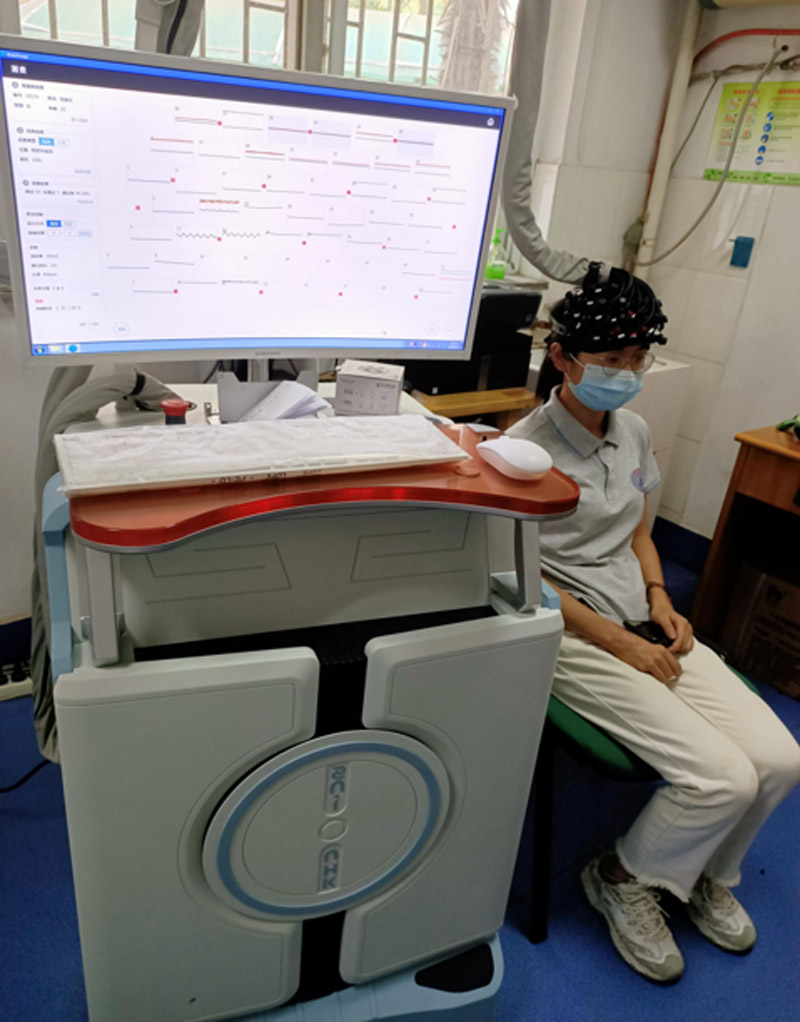
Site of near-infrared data acquisition with university student subjects
- [1] M. D. Schulkind, “Long-term memory for temporal structure: Evidence form the identification of well-known and novel songs,” Memory & Cognition, Vol.27, No.5, pp. 896-906, 1999. https://doi.org/10.3758/BF03198542
- [2] P. Janata and S. T. Grafton, “Swinging in the brain: Shared neural substrates for behaviors related to sequencing and music,” Nature neuroscience, Vol.6, No.7, pp. 682-687, 2003. https://doi.org/10.1038/nn1081
- [3] M. Wallentin, A. H. Nielsen, M. Friis-Olivarius et al., “The musical ear test, a new reliable test for measuring musical competence,” Learning and Individual Differences, Vol.20, No.3, pp. 188-196, 2010. https://doi.org/10.1016/j.lindif.2010.02.004
- [4] P. Vuust, O. A. Heggli, K. J. Friston et al., “Music in the brain,” Nature Reviews Neuroscience, Vol.23, No.5, pp. 287-305, 2022. https://doi.org/10.1038/s41583-022-00578-5
- [5] E. A. Miendlarzewska and W. J. Trost, “How musical training affects cognitive development: Rhythm, reward and other modulating variables,” Frontiers in neuroscience, Vol.7, Article No.279, 2014. https://doi.org/10.3389/fnins.2013.00279
- [6] H. A. Rafael, V. Patricia, G. M. Z. Augusto et al., “Hand motor learning in a musical context and prefrontal cortex hemodynamic response: A functional near-infrared spectroscopy (fNIRS) study,” Cognitive Processing, Vol.20, No.4, pp. 507-513, 2019. https://doi.org/10.1007/s10339-019-00925-y
- [7] E. Jeong, H. Ryu, G. Jo et al., “Cognitive load changes during music listening and its implication in earcon design in public environments: An fNIRS study,” Int. J. of environmental research and public health, Vol.15, No.10, pp. 2075-2075, 2018. https://doi.org/10.3390/ijerph15102075
- [8] K. T. Nakahira, M. Akahane, and Y. Fukami, “Process of acquiring musical performance skills for enhanced “Awareness” given by a multimedia-based learning approach,” J. Adv. Comput. Intell. Intell. Inform., Vol.15, No.9, pp. 1241-1247, 2011. https://doi.org/10.20965/jaciii.2011.p1241
- [9] T. P. Zanto, V. Johnson, A. Ostrand, and A. Gazzaley, “How musical rhythm training improves short-term memory for faces,” Proc. of the National Academy of Sciences, Vol.119, No.41, Article No.e2201655119, 2022. https://doi.org/10.1073/pnas.2201655119
- [10] M. Zheng, H. Lin, and F. Chen, “An fNIRS study on the effect of music style on cognitive activities,” 42nd Annual Int. Conf. of the IEEE Engineering in Medicine and Biology Society: Enabling Innovative Technologies for Global Healthcare (EMBC’20), pp. 3200-3203, 2020. https://doi.org/10.1109/EMBC44109.2020.9176441
- [11] J. Ginzburg, A. Cheylus, E. Collard et al., “Role of the prefrontal cortex in musical and verbal short-term memory: A functional near-infrared spectroscopy study,” Imaging Neuroscience, pp. 21-23, 2024. https://doi.org/10.1162/imag_a_00168
- [12] Y. Miao and S. Hao, “The effects of tactile aids in video games for children’s rhythmic coordination training: An fNIRS study,” Neuroscience Letters, Vol.837, Article No.137901, 2024. https://doi.org/10.1016/j.neulet.2024.137901
- [13] R. Niu, Y. Yu, Y. Li et al., “Use of fNIRS to characterize the neural mechanism of inter-individual rhythmic movement coordination,” Frontiers in Physiology, Vol.10, Article No.781, 2019. https://doi.org/10.3389/fphys.2019.00781
- [14] A. D. Patel, “Language, music, syntax and the brain,” Nature Neuroscience, Vol.6, No.7, pp. 674-681, 2003. https://doi.org/10.1038/nn1082
- [15] S. Koelsch, “Significance of Broca’s area and ventral premotor cortex for music-syntactic processing,” Cortex, Vol.42, No.4, pp. 518-520, 2006. https://doi.org/10.1016/S0010-9452(08)70390-3
- [16] Y. Nan and A. D. Friederici, “Differential roles of right temporal cortex and Broca’s area in pitch processing: Evidence from music and Mandarin,” Human Brain Mapping, Vol.34, No.9, pp. 2045-2054, 2013. https://doi.org/10.1002/hbm.22046
- [17] P. Pinti, I. Tachtsidis, A. Hamilton et al., “The present and future use of functional near‐infrared spectroscopy (fNIRS) for cognitive neuroscience,” Annals of the New York Academy of Sciences, Vol.1464, No.1, pp. 5-29, 2020. https://doi.org/10.1111/nyas.13948
- [18] D. T. Delpy and M. Cope, “Quantification in tissue near-infrared spectroscopy,” Philosophical Trans. of the Royal Society of London Series B: Biological Sciences, Vol.352, No.1354, pp. 649-659, 1997. https://doi.org/10.1098/rstb.1997.0046
- [19] F. Curzel, B. Tillmann, and L. Ferreri, “Lights on music cognition: A systematic and critical review of fNIRS applications and future perspectives,” Brain and Cognition, Vol.180, Article No.106200, 2024. https://doi.org/10.1016/j.bandc.2024.106200
- [20] B. Giulio, K. Emanuela, W. Martin et al., “Increase in low-frequency oscillations in fNIRS as cerebral response to auditory stimulation with familiar music,” Brain Sciences, Vol.12, No.1, Article No.42, 2021. https://doi.org/10.3390/brainsci12010042
- [21] M. Bigliassi, V. Barreto-Silva, and R. L. Altimari, “How motivational and calm music may affect the prefrontal cortex area and emotional responses: A functional near-infrared spectroscopy (fNIRS) study,” Perceptual and Motor Skills, Vol.120, No.1, pp. 202-218, 2015. https://doi.org/10.2466/27.24.PMS.120v12x5
- [22] S. Hao, Q. Wang, Y. Zhang et al., “The effect of different visual feedback interfaces of music training games on speech rehabilitation in hearing-impaired children: An fNIRS study,” Neuroscience Letters, Vol.843, Article No.138010, 2024. https://doi.org/10.1016/j.neulet.2024.138010
- [23] K. Ding, J. Li, and X. Li et al., “Understanding the effect of listening to music, playing music, and singing on brain function: A scoping review of fNIRS studies,” Brain Sciences, Vol.14, No.8, Article No.751-751, 2024. https://doi.org/10.3390/brainsci14080751
- [24] J. C. Wang, R. J. Xu, B. X. Huang, X. L. Guo, Y. B. Cheng, D. Z. Yao, and J. Lu, “Effects and mechanisms of brain-wave music intervention on fatigue,” J. of Fudan University (Natural Science), Vol.62, No.1, pp. 63-68,82, 2023.
- [25] W. C. Hua, H. P. Lian, and Y. J. Li, “Investigation of the effect of pitch on emotional responses to music using EEG functional connectivity,” Beijing Biomedical Engineering, Vol.42, No.1, pp. 9-15, 2023.
- [26] R. Cabredo, R. Legaspi, P. S. Inventado, and M. Numao, “Discovering emotion-inducing music features using EEG signals,” J. Adv. Comput. Intell. Intell. Inform., Vol.17, No.3, pp. 362-370, 2013. https://doi.org/10.20965/jaciii.2013.p0362
- [27] D. Tanaka, R. Suzuki, and S. Kato, “A kansei-based sound modulation system for musical instruments by using neural networks,” J. Adv. Comput. Intell. Intell. Inform., Vol.23, No.3, pp. 437-443, 2019. https://doi.org/10.20965/jaciii.2019.p0437
- [28] V. Alluri, P. Toiviainen, I. P. Jaaskelainen, E. Glerean, M. Sams, and E. Brattico, “Large-scale brain networks emerge from dynamic processing of musical timbre, key and rhythm,” Neuroimage, Vol.59, No.4, pp. 3677-3689, 2012. https://doi.org/10.1016/j.neuroimage.2011.11.019
- [29] X. Cao, Y. Zhang, H. Wu, H. Da, Q. Xiao, and H. Shi, “Decoding depression: How DLPFC and SMA mediate stress perception’s role in mental health?,” J. of Affective Disorders, Vol.379, pp. 323-331, 2025. https://doi.org/10.1016/j.jad.2025.03.036
- [30] T. Sungho and J. C. Ye, “Statistical analysis of fNIRS data: A comprehensive review,” Neuroimage, Vol.85, pp. 72-91, 2014. https://doi.org/10.1016/j.neuroimage.2013.06.016
- [31] T. T. Zhang and Q. Q. Du, “A study of brain-neural mechanism and formal experience of music psychological aesthetics,” J. of the Northern Music, No.2, pp. 92-100, 2024.
This article is published under a Creative Commons Attribution-NoDerivatives 4.0 Internationa License.