
Paper:
Collision Detection of Small Paddy-Field Robots with Soft Obstacles Based on Wavelet Analysis of Estimated Collision Force
Kentaro Kameyama
 and Rikuto Iizuka
National Institute of Technology, Fukui College
Geshi, Sabae, Fukui 916-0029, Japan

This study investigates a method for collision detection caused by soft and deformable obstacles, such as soil and plants (soft obstacles). Field robots must operate while interacting with the soft obstacles in their environments. However, previous studies on collision detection have primarily focused on hard obstacles, such as rocks and artificial structures, and research addressing soft obstacles has been limited. Because soft obstacles absorb impact forces, collision detection using conventional methods is challenging, and determining the collision time is even more difficult. To address these challenges, this study proposes a method that estimates the states, including unknown collision forces, using an extended Kalman filter. A wavelet transform is then applied to the estimated values to detect collisions. The effectiveness of the proposed method was validated using experimental data obtained from a water tank.
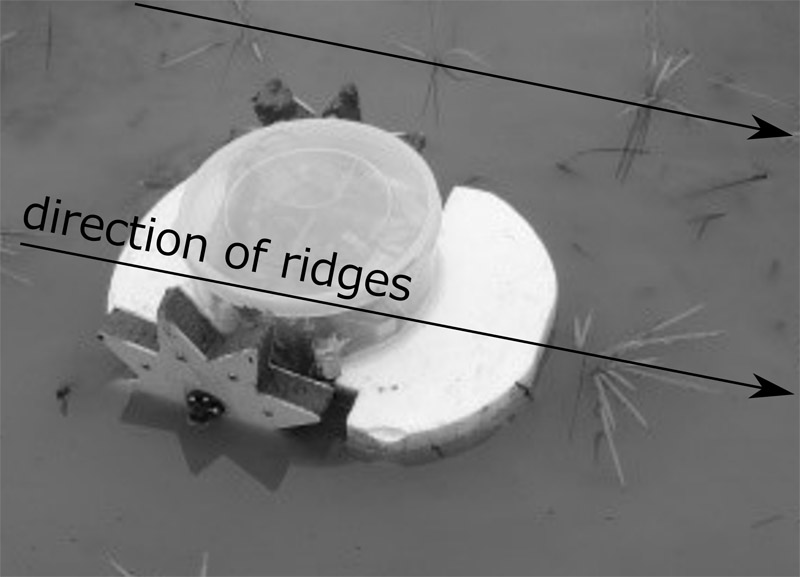
Example of stranding of a small paddy-field robot (riding over an underwater obstacle)
- [1] M. Seki, H. Nishida, and K. Takahashi, “Development of an environment-harmonized weeding robot system (1st report),” J. of the Japanese Society of Agricultural Machinery, Vol.60, pp. 109-110, 1998 (in Japanese).
- [2] M. Seki, H. Nishida, K. Takahashi, and K. Kojima, “Development of an environment-harmonized weeding robot system (2nd report),” J. of the Japanese Society of Agricultural Machinery, Vol.61, pp. 277-278, 1999 (in Japanese).
- [3] M. Seki, H. Nishida, K. Takahashi, and K. Kojima, “Development of an environment-harmonized weeding robot system (3rd report),” J. of the Japanese Society of Agricultural Machinery, Vol.62, pp. 51-52, 2000 (in Japanese).
- [4] A. Maruyama and K. Naruse, “Development of small weeding robots for rice fields,” 2014 IEEE/SICE Int. Symp. on System Integration (SII 2014), pp. 99-105, 2014. https://doi.org/10.1109/SII.2014.7028019
- [5] K. Iwakabe, Y. Yamada, G. Liu, and T. Uejima, “Development of a paddy field mobile robot for the purpose of paddy quality improvement,” Proc. of SICE Annual Conf., pp. 1618-1622, 2013.
- [6] K. Iwakabe, S. Kunii, D. Nakai, Y. Yamada, and T. Uejima, “Design and implementation of a paddy field mobile robot for the purpose of paddy quality improvement,” Proc. of 2013 Int. Symp. on Advanced Mechanical Engineering and Power Engineering (ISAMPE2013), 2013.
- [7] Y. Iwano, A. Tanaka, and K. Iizuka, “Development of a flail-type mowing system,” J. Robot. Mechatron., Vol.37, No.3, pp. 555-562, 2025. https://doi.org/10.20965/JRM.2025.P0555
- [8] S. Haddadin, A. D. Luca, and A. Albu-Schäffer, “Robot collisions: A survey on detection, isolation, and identification,” IEEE Trans. on Robotics, Vol.33, No.6, pp. 1292-1312, 2017. https://doi.org/10.1109/TRO.2017.2723903
- [9] Y. Nakagawa and K. Demura, “Collision estimation from information of an omni-directional camera,” The Proc. of JSME Annual Conf. on Robotics and Mechatronics (ROBOMECH2006), Article No.2P1-B04, 2006. https://doi.org/10.1299/jsmermd.2006._2P1-B04_1
- [10] M. Hoy, A. S. Matveev, and A. V. Savkin, “Algorithms for collision-free navigation of mobile robots in complex cluttered environments: A survey,” Robotica, Vol.33, No.3, pp. 463-497, 2015. https://doi.org/10.1017/S0263574714000289
- [11] M. Yamamoto, Y. Nakashima, M. Hashimoto, and T. Yanaga, “Obstacle-detection bumper for a semi-automatic mower robot suitable for steep slope field,” The Proc. of JSME Annual Conf. on Robotics and Mechatronics (ROBOMECH2018), Article No.2A2-C01, 2018. https://doi.org/10.1299/jsmermd.2018.2a2-c01
- [12] H. Nakazawa, K. Nakamura, and K. Naruse, “Collision identification in weeding robot with acceleration sensor,” Proc. of JSPE Conf., pp. 9-10, 2016. https://doi.org/10.11522/PSCJSPE.2016A.0_9
- [13] K. Kameyama, D. Mitta, A. Kawasaki, and O. Ankbayar, “Collision detection and stranding prediction of small robots for paddy fields against soft obstacles,” Trans. of the Society of Instrument and Control Engineers, Vol.58, No.4, pp. 213-220, 2022. https://doi.org/10.9746/sicetr.58.213.
- [14] K. Kameyama, T. Yasuoka, R. Kawakami, and N. Asai, “G150031 development of the robot to inhibit growth of weeds in the paddy field,” The Proc. of Mechanical Engineering Congress, Japan 2012, pp. G150031-1-G150031-4, 2012. https://doi.org/10.1299/jsmemecj.2012._G150031-1
- [15] K. Kameyama and T. Wada, “Adaptation of a small robot for paddy fields to the water depth change using variable legs,” J. Robot. Mechatron., Vol.34, No.1, pp. 159-166, 2022. https://doi.org/10.20965/JRM.2022.P0159
- [16] A. Ohsumi, K. Kameyama, and Y. Matuda, “Kalmanfilter and Identification of Systems – An approach to Dynamical Inverse Problem,” Morikita Publishing Co., Ltd., 2016.
This article is published under a Creative Commons Attribution-NoDerivatives 4.0 Internationa License.