
Paper:
Empirical Evaluation of Activity Coordination Among Field Response Agencies Using ICT Solutions
Kazuo Tsutsui*,**,†, Machiko Iida**, Hayato Kudo*,**, Takeshi Isono*,**, Kazushiro Yoshimori*,**, Kenichi Takahashi*, Hiroaki Sano*,**
 , and Tadashi Ise*,**
*Research Division for Disaster Information and Intelligence, National Research Institute for Earth Science and Disaster Resilience (NIED)
3-1 Tennodai, Tsukuba, Ibaraki 305-0006, Japan
**Collaborative Research Center for Advanced Resilience Technology, National Research Institute for Earth Science and Disaster Resilience (NIED)
Tsukuba, Japan
†Corresponding author

This study empirically evaluates ICT-based coordination among Japanese disaster response agencies during the acute life-saving phase. Although national guidelines mandate inter-agency cooperation, agencies (fire services, police, and Self-Defense Forces) operate as self-contained silos with few joint verification drills. To overcome this structural barrier, we conducted two empirical experiments in FY2025. The first, a joint rescue drill in Aichi Prefecture evaluating a three-tiered coordination structure (prefecture, municipality, and field command), verified system functions for facilitating smooth activity coordination among response agencies. The second, a regional joint drill in the Chubu block testing cross-system data integration, focused on the real-time acquisition and layer-overlay sharing of vehicle passage records on SIP4D-Xedge and SOBO-WEB to secure access routes to isolated areas. Post-drill surveys and observational analysis confirmed high coordination achievement, demonstrating that a common operational picture (COP) was positively evaluated by participants and suggested the potential to support situational visibility and operational area division. Moreover, key technical requirements were identified, including offline caching/synchronization against tunnel communication blackouts and standardized UI symbology across agencies. Ultimately, effective coordination requires standardized sharing rules, platform integration into routine operations, and robust COP generation visualizing unit capabilities and passage records to accelerate life-saving efforts.
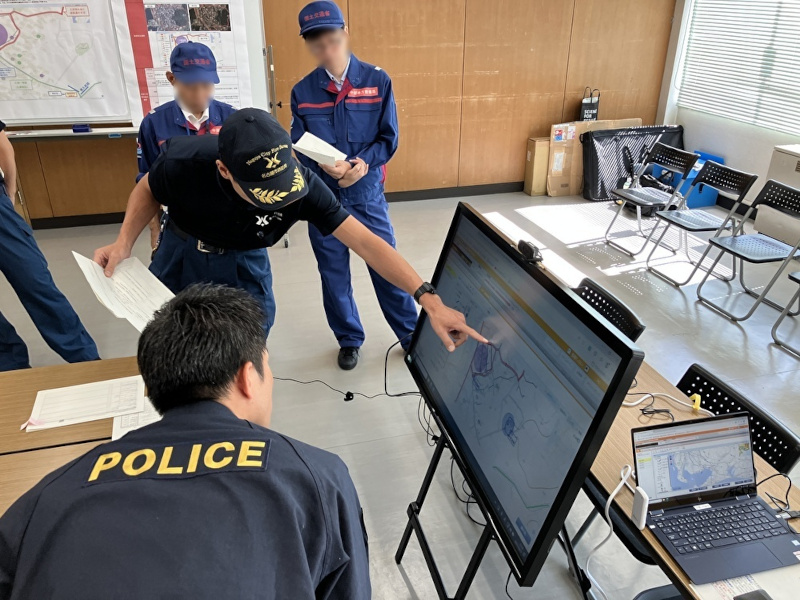
Multi-agency coordination using system
- [1] Fire and Disaster Management Agency (FDMA), Ministry of Internal Affairs and Communications, “Operational guidelines for inter-agency cooperation in search and rescue activities during catastrophic disasters,” (in Japanese). https://www.fdma.go.jp/mission/prepare/cooperation/post.html [Accessed March 20, 2026]
- [2] Wide Area Support Office, Fire and Disaster Management Agency (FDMA), Ministry of Internal Affairs and Communications, “Information on emergency fire response teams,” 2025 (in Japanese). https://www.fdma.go.jp/publication/ugoki/items/rei_0706_24.pdf [Accessed August 22, 2026]
- [3] National Police Agency, “Notice on the organization, operation, etc. of the police disaster dispatch unit,” NPA Heibi-3 No.26 etc., 2024 (in Japanese). https://www.npa.go.jp/laws/notification/keibi/keibi3/keibi3_20240829_2.pdf [Accessed August 22, 2026]
- [4] Ministry of Defense and Self-Defense Forces, “Disaster relief operations,” (in Japanese). https://www.mod.go.jp/j/approach/defense/saigai/index.html [Accessed August 22, 2026]
- [5] K. Kato, “Inter-organizational co-operation in natural disasters: NPA, FDMA, JSDF and JCG’s domain and co-operation in EOC,” Studies in Humanities and Social Sciences (Social Sciences Series), Vol.102, pp. 47-94, 2011 (in Japanese).
- [6] T. Nakazawa, “Addressing natural disasters with the capabilities of the SDF: Achieving seamless responses by the relevant organizations,” NIDS J. of Defense and Security, Vol.18, No.1, pp. 75-108, 2015 (in Japanese).
- [7] E. Wang, D. Zheng, and X. Li, “Cross-organizational information sharing and coordination in disaster response: The case of the 2008 Wenchuan China Earthquake,” J. Disaster Res., Vol.10, No.2, pp. 363-372, 2015. https://doi.org/10.20965/jdr.2015.p0363
- [8] K. Saito and M. Umemoto, “Comparison of standardized incident management systems in developed countries and consideration of the feasibility of introducing these systems in Japan,” J. of Social Safety Science, Vol.44, pp. 25-35, 2024 (in Japanese). https://doi.org/10.11314/jisss.44.25
- [9] Y. Okita, “Standardisation of the coordination mechanism for international USAR teams: Examples from the INSARAG marking and assessment forms,” J. of Social Safety Science, Vol.26, pp. 1-10, 2015 (in Japanese). https://doi.org/10.11314/jisss.26.1
- [10] Y. Okita and T. Katsube, “Coordination of international urban search and rescue (USAR) teams in the 2015 Nepal Earthquake: ‘Disaster literacy’ for international USAR,” J. of Japan Association for Earthquake Engineering, Vol.15, No.6, pp. 6_112-6_125, 2015 (in Japanese). https://doi.org/10.5610/jaee.15.6_112
- [11] M. Iida, H. Kudo, K. Tsutsui, T. Isono, S. Sato, A. Furukawa, and T. Ise, “Survey and consideration of the actual situation of activity coordination meetings among field response agencies: Case studies of the 2024 Noto Peninsula Earthquake and the 2024 Oku-Noto Heavy Rains,” J. of Natural Disaster Science, Vol.44, No.S12, pp. 81-93, 2025 (in Japanese). https://doi.org/10.24762/jndsj.44.S12_81
- [12] Y. Hada, N. Kodama, T. Suzuki, I. Suetomi, and K. Meguro, “A study on road information sharing using probe vehicle data in disasters,” Proc. of the JSCE Earthquake Engineering Symp., Vol.29, pp. 801-809, 2007 (in Japanese). https://doi.org/10.11532/proee2005a.29.801
- [13] N. Kodama, Y. Hada, T. Suzuki, and K. Meguro, “Numerical simulation of road information gathering and travel time saving in disaster by sharing probe vehicle data,” J. of Disaster Information Studies, Vol.6, pp. 89-94, 2008 (in Japanese). https://doi.org/10.24709/jasdis.6.0_89
- [14] Y. Hada, T. Suzuki, H. Shimora, K. Meguro, and N. Kodama, “Issues and future prospect on practical use of probe vehicle data for disaster reduction—Provision of the vehicle tracking map in the 2007 Niigataken Chuetsu-oki Earthquake—,” J. of Japan Association for Earthquake Engineering, Vol.9, No.2, pp. 2_148-2_159, 2009 (in Japanese). https://doi.org/10.5610/jaee.9.2_148
- [15] T. Mizutani, S. Itubo, D. Toriumi, and H. Makino, “Feasibility study of identifying passable routes after disasters made from ETC2.0 probe data,” 14th ITS Symp., 2016.
- [16] T. Ise, M. Iida, K. Yoshimori, H. Kudo, K. Tsutsui, and A. Furukawa, “Issues regarding information sharing of field response agencies in the 2024 Noto Peninsula Earthquake: Considerations regarding the role and limitations of the ISUT-SITE,” J. of Japan Society for Natural Disaster Science, Vol.43, No.3, pp. 427-435, 2024 (in Japanese). https://doi.org/10.24762/jndsj.43.3_427
This article is published under a Creative Commons Attribution-NoDerivatives 4.0 Internationa License.