
Paper:
Transforming Inclusive Disaster Risk Reduction in Ecuador (Phase II): From Institutionalization to Standardized Governance Through SOP Co-Production
Shigeo Tatsuki*,**,†

*Doshisha University
Kyoto , Japan
**Research Center, Institute of Social Safety Science
Tokyo, Japan
†Corresponding author

Disability mainstreaming in disaster risk reduction (DRR) is widely endorsed in international policy frameworks, yet operationalization at the local level remains challenging. In Ecuador, Phase I of an inclusive DRR initiative established institutional foundations through municipal ordinances in four model municipalities and a subsequent inter-ministerial agreement aligning national disability and disaster risk authorities. Building on this foundation, Phase II focused on translating institutional commitment into operationally actionable procedures. This study reports the longitudinal co-production of standard operating procedures (SOPs) conducted between February 2025 and January 2026. Using participatory workflow analysis, stakeholders from four municipalities and national field offices collaboratively externalized, structured, and iteratively refined their operational practices through three workshop nodes and inter-session communication. Stakeholder-based swimlane diagrams were employed to visualize task sequences and explicitly anchor decision points to responsible actors. Results demonstrate a progressive increase in the resolution of stakeholder and decision architecture. Broad institutional categories evolved into differentiated functional roles, and implicit coordination was transformed into explicit, actor-specific judgment mapping. Over time, analytical logic was internalized by participants, enabling participant-led consolidation and horizontal expansion to additional municipalities. The findings suggest that operationalizing disability mainstreaming requires more than legal alignment; it requires the structured clarification of distributed responsibility and judgment. By conceptualizing SOP co-production as a mechanism of organizational learning and social technology formation, this study contributes to both workflow analysis and the practical advancement of inclusive DRR.
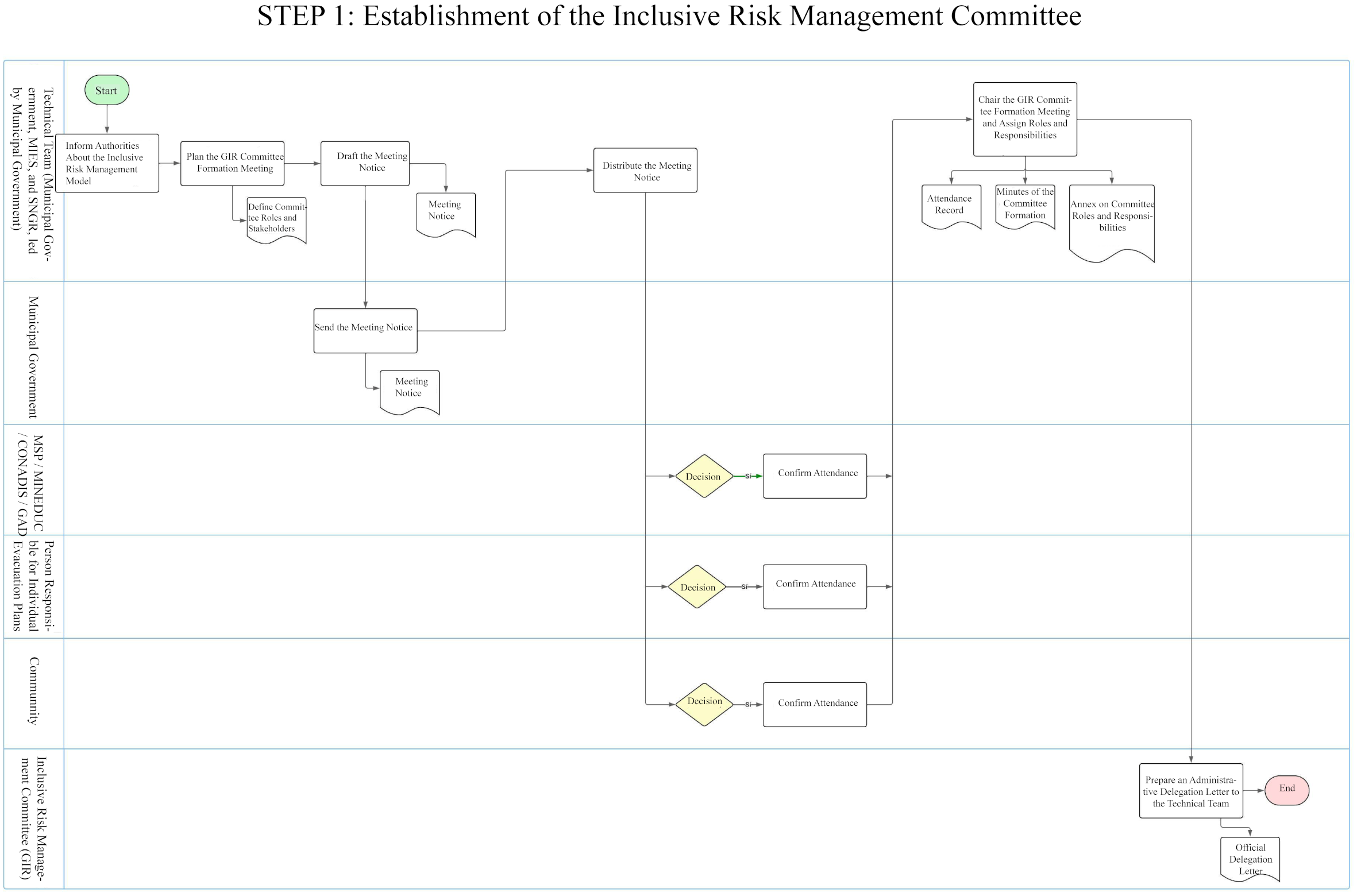
Step 1 workflow diagram
- [1] United Nations, “Convention on the Rights of Persons with Disabilities,” 2006.
- [2] United Nations Office for Disaster Risk Reduction (UNDRR), “Sendai Framework for Disaster Risk Reduction 2015–2030,” 2015.
- [3] J. L. Pressman and A. Wildavsky, “Implementation: How great expectations in Washington are dashed in Oakland; or why it’s amazing that federal programs work at all, this being a saga of the economic development administration as told by two sympathetic observers who seek to build morals on a foundation of ruined hopes,” University of California Press, 1973.
- [4] R. R. Nelson and B. N. Sampat, “Making sense of institutions as a factor shaping economic performance,” J. Econ. Behav. Organ., Vol.44, No.1, pp. 31-54, 2001. https://doi.org/10.1016/S0167-2681(00)00152-9
- [5] E. Ostrom, “Crossing the great divide: Coproduction, synergy, and development,” World Dev., Vol.24, No.6, pp. 1073-1087, 1996. https://doi.org/10.1016/0305-750X(96)00023-X
- [6] C. Argyris and D. A. Schön, “Organizational learning: A theory of action perspective,” Addison-Wesley, 1978.
- [7] I. Nonaka, “A dynamic theory of organizational knowledge creation,” Organ. Sci., Vol.5, No.1, pp. 14-37, 1994. https://doi.org/10.1287/orsc.5.1.14
- [8] Cabinet Office (Disaster Management Bureau), Government of Japan, “Guidelines for Supporting the Evacuation of Persons Requiring Assistance,” originally issued in 2013, revised in 2021, and updated in 2025.
- [9] A. Tsujioka, Y. Honjyo, J. Umemura, and S. Tatsuki, “Administrative process analysis of making individual support plan: Case study of Takashima city, Shiga Prefecture,” J. Soc. Saf. Sci., Vol.41, pp. 333-343, 2022 (in Japanese). https://doi.org/10.11314/jisss.41.333
- [10] S. L. Star and J. R. Griesemer, “Institutional ecology, ‘translations’ and boundary objects: Amateurs and professionals in Berkeley’s Museum of Vertebrate Zoology, 1907–1939,” Soc. Stud. Sci., Vol.19, No.3, pp. 387-420, 1989. https://doi.org/10.1177/030631289019003001
- [11] P. J. DiMaggio and W. W. Powell, “The iron cage revisited: Institutional isomorphism and collective rationality in organizational fields,” Am. Sociol. Rev., Vol.48, No.2, pp. 147-160, 1983. https://doi.org/10.2307/2095101
This article is published under a Creative Commons Attribution-NoDerivatives 4.0 Internationa License.