
Paper:
Artificial Island Construction as a Climate Adaptation Strategy for the Right to Stay: Perspectives from Kiribati University Students
Takuia Uakeia* and Mikiyasu Nakayama**,†

*University of the South Pacific
PO Box 59, Bairiki, Kiribati
**Global Infrastructure Fund Research Foundation Japan
Tokyo, Japan
†Corresponding author

This study investigates the prospect of artificial island construction as a climate change adaptation strategy for Kiribati, focusing on university students. A survey of 85 students at the University of the South Pacific Tarawa Campus examined attitudes toward climate change, migration, and artificial islands as a means to support the “right to stay.” Exploratory factor analysis identified eleven factors explaining 74.6% of total variance in attitudes, grouped into four dimensions: (1) Adaptation Strategy Preference, including artificial islands, domestic relocation, and physical protection measures; (2) Migration Attitude, encompassing planned international migration and liberation from social obligations; (3) Current Situation Evaluation, reflecting satisfaction with living conditions and services; and (4) Rights and Responsibility Recognition, concerning climate justice and the “right to stay.” Positive Evaluation of Artificial Islands emerged as the most significant factor, accounting for 13.7% of variance. The findings reveal a strong desire to preserve I-Kiribati culture alongside mixed responses to artificial islands. Some respondents view artificial island construction as a promising option for maintaining sovereignty and cultural continuity, while others express concerns about safety, environmental impacts, and costs. The survey also highlights diverse migration perspectives, with interest in both domestic relocation and international emigration. These results should be interpreted cautiously due to the limited university-student sample, which may not represent Kiribati’s broader population. Nevertheless, the study offers insights into the complex, multidimensional attitudes of young I-Kiribati toward climate adaptation. The findings suggest that artificial islands could form part of a broader adaptation portfolio, complemented by international financial assistance, vocational training, and efforts to secure the rights of I-Kiribati migrants. This research contributes to discussions on climate justice and adaptation policy in low-lying island nations facing sea-level rise.
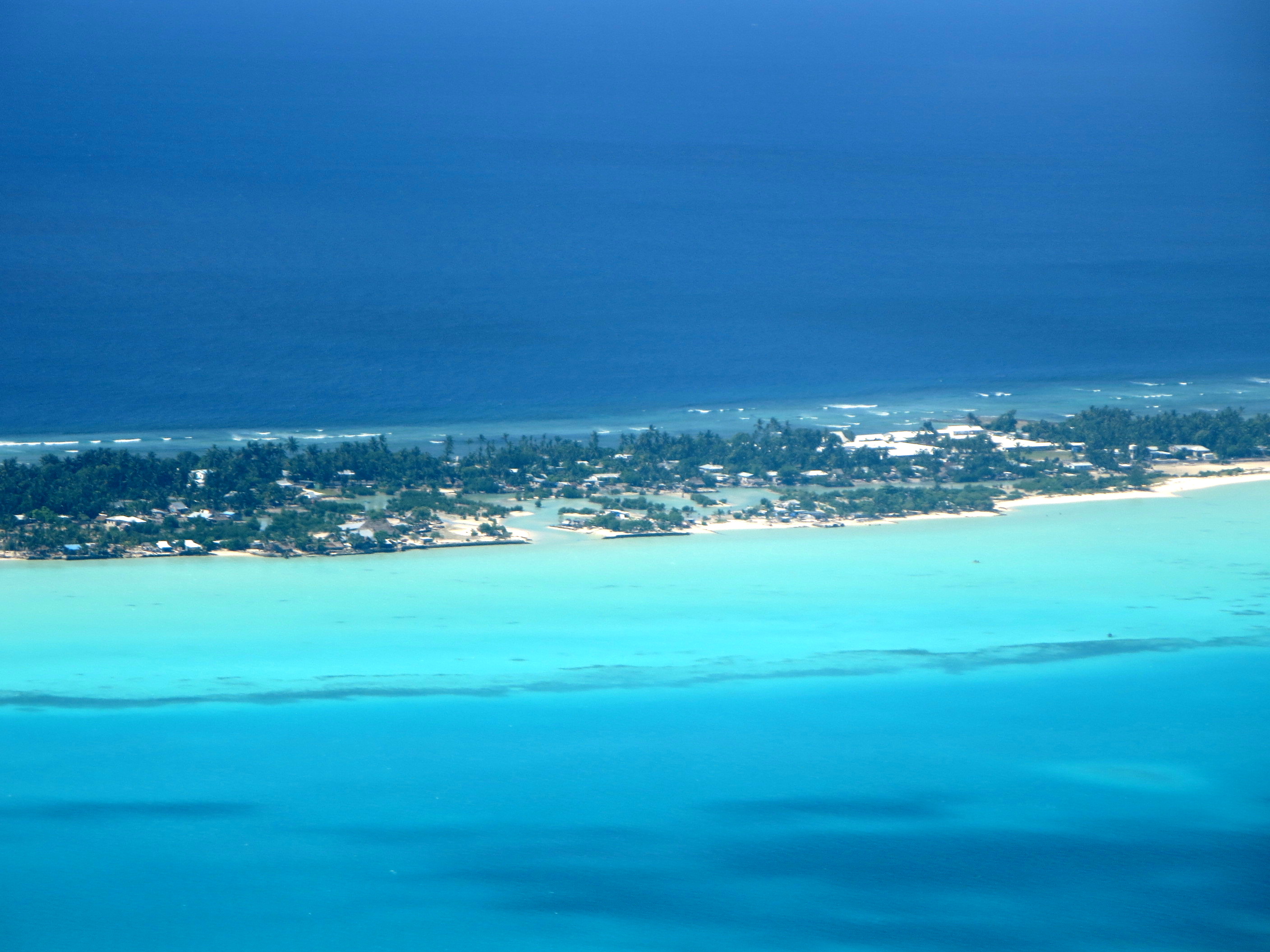
South Tarawa, Kiribati
- [1] M. Nakayama, J. Seru, C. Vila, M. Bilimon, R. Fujikura, A. Sakamoto, and M. Sato, “Artificial island construction as an instrument for the right to stay: Case of the Marshall Islands,” J. Disaster Res., Vol.20, No.1, pp. 44-52, 2025. https://doi.org/10.20965/jdr.2025.p0044
- [2] PSM News, “Total population of the Maldives recorded at over 500,000,” March 31, 2023. https://psmnews.mv/en/118961 [Accessed January 23, 2025]
- [3] The Maldives Journal, “Malé area population on the rise: Census reveals increase in residents,” April 1, 2023. https://themaldivesjournal.com/48882 [Accessed January 23, 2025]
- [4] Avas, “Hulhumalé population at 92,000,” July 16, 2024. https://avas.mv/en/120130 [Accessed January 23, 2025]
- [5] D. Cubie, “In-situ adaptation: Non-migration as a coping strategy for vulnerable persons,” D. Manou, A. Baldwin, D. Cubie, A. Mihr, and T. Thorp (Eds.), “Climate change, migration and human rights,” pp. 99-114, Routledge, 2017.
- [6] M. Nakayama, R. Fujikura, R. Okuda, M. Fujii, R. Takashima, T. Murakawa, E. Sakai, and H. Iwama, “Alternatives for the Marshall Islands to cope with the anticipated sea level rise by climate change,” J. Disaster Res., Vol.17, No.3, pp. 315-326, 2022. https://doi.org/10.20965/jdr.2022.p0315
- [7] A. Sakamoto, K. Nishiya, X. Guo, A. Sugimoto, W. Nagasaki, and K. Doi, “Mitigating impacts of climate change induced sea level rise by infrastructure development: Case of the Maldives,” J. Disaster Res., Vol.17, No.3, pp. 327-334, 2022. https://doi.org/10.20965/jdr.2022.p0327
- [8] D. Sasaki, K. Nishiya, X. Guo, A. Sugimoto, W. Nagasaki, and K. Doi, “Facilitating the smooth migration of inhabitants of atoll countries to artificial islands: Case of the Maldives,” Sustainability, Vol.16, No.11, Article No.4582, 2024. https://doi.org/10.3390/su16114582
- [9] M. Maekawa, R. A. Raheem, A. Khalid, A. Sakamoto, M. Nakayama, D. Sasaki, and H. Okaniwa, “Motivations and life satisfaction on voluntary migration to Hulhumalé,” J. Disaster Res., Vol.20, No.1, pp. 25-36, 2025. https://doi.org/10.20965/jdr.2025.p0025
- [10] A. Sakamoto, M. Maekawa, A. Aslam, A. Laila, K. Kikuchi, T. Kaku, K. Kataoka, M. Matsuda, K. Taiko, and M. Nakayama, “Life satisfaction and migration motivations of the residents of Hulhumalé from Malé and other atolls,” J. Disaster Res., Vol.20, No.1, pp. 15-24, 2025. https://doi.org/10.20965/jdr.2025.p0015
This article is published under a Creative Commons Attribution-NoDerivatives 4.0 Internationa License.