
Paper:
Interdisciplinary and Transdisciplinary Approaches in an International Research Project for Climate Resilience: The HyDEPP-SATREPS Project Between the Philippines and Japan
Miho Ohara*,†, Patricia Ann Jaranilla-Sanchez**
 , and Fernando C. Sanchez, Jr.**
*The University of Tokyo
Be505, 4-6-1 Komaba, Meguro-ku, Tokyo 153-8505, Japan
†Corresponding author
**University of the Philippines Los Baños
Los Baños, Philippines

Interdisciplinary and transdisciplinary collaboration is becoming increasingly critical for disaster risk reduction and climate change adaptation as climate change accelerates. The authors have been leading an international research project between the Philippines and Japan to demonstrate how interdisciplinary and transdisciplinary approaches can explore new solutions toward sustainable development under future climate change. The project aims to evaluate future climate change impacts through the development of hybrid water-related disaster risk assessment technology combining climate change, hydrological, agricultural, and socio-economic models; further, it aims to provide policy recommendations to support sustainable local economic development. As each model had been separately developed by project members, both interdisciplinary and transdisciplinary approaches were necessary to integrate the individual models into a single hybrid model and apply it to the target area. However, project activities were limited due to COVID-19, especially because of travel restrictions and the lack of face-to-face or on-site visiting opportunities. Hence, various measures were adopted to efficiently undertake project activities even under such circumstances. This study analyzes the interdisciplinary and transdisciplinary approaches used under the project, focusing on the process of team building, co-creation of solution-oriented and transferable knowledge, and its integration. The difficulties in each process during COVID-19, the needs for interdisciplinary and transdisciplinary approaches, the ways explored to manage these needs, and lessons are described.
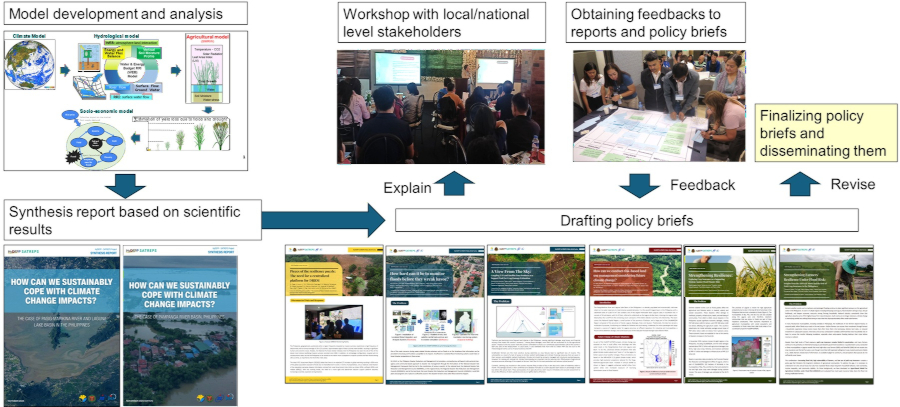
Process of dialogue with stakeholders
- [1] United Nations Office for Disaster Risk Reduction, “Disaster risk reduction and resilience in the 2030 Agenda for Sustainable Development.” https://www.preventionweb.net/files/46052_disasterriskreductioninthe2030agend.pdf [Accessed September 30, 2025]
- [2] The Global Goals, “The 17 goals.” https://globalgoals.org/goals/ [Accessed September 30, 2025]
- [3] T. Koike, “Presentation at the Asian Water Cycle Initiative (AWCI) session,” Asia-Oceania Group on Earth Observations (AOGEO), 2021. https://www.pwri.go.jp/icharm/ifi/awci/topics/20211029_14/6-1_Koike.pdf [Accessed September 30, 2025]
- [4] A. T. Ismail-Zadeh, S. L. Cutter, K. Takeuchi, and D. Paton, “Forging a paradigm shift in disaster science,” Nat. Hazards, Vol.86, No.2, pp. 969-988, 2017. https://doi.org/10.1007/s11069-016-2726-x
- [5] K. Takara, “Promotion of interdisciplinary and transdisciplinary collaboration in disaster risk reduction,” J. Disaster Res., Vol.13, No.7, pp. 1193-1198, 2018. https://doi.org/10.20965/jdr.2018.p1193
- [6] M. Ishiwatari et al., “Transdisciplinary approach: Toward innovative recovery and disaster risk reduction,” J. Disaster Res., Vol.19, No.3, pp. 534-538, 2024. https://doi.org/10.20965/jdr.2024.p0534
- [7] A. Bendito and E. Barios, “Convergent agency: Encouraging transdisciplinary approaches for effective climate change adaptation and disaster risk reduction,” Int. J. Disaster Risk. Sci., Vol.7, No.4, pp. 430-435, 2016. https://doi.org/10.1007/s13753-016-0102-9
- [8] D. J. Lang et al., “Transdisciplinary research in sustainability science: Practice, principles, and challenges,” Sustain. Sci., Vol.7, Suppl.1, pp. 25-43, 2012. https://doi.org/10.1007/s11625-011-0149-x
- [9] P. Brandt et al., “A review of transdisciplinary research in sustainability science,” Ecological Economics, Vol.92, pp. 1-15, 2013. https://doi.org/10.1016/j.ecolecon.2013.04.008
- [10] https://weltrisikobericht.de/worldriskreport/ [Accessed September 30, 2025]
- [11] T. Ushiyama, A. Hasegawa, M. Miyamoto, and Y. Iwami, “Dynamic downscaling and bias correction of rainfall in the Pampanga River basin, Philippines, for investigating flood risk changes due to global warming,” Hydrol. Res. Lett., Vol.10, No.3, pp. 106-112, 2016. https://doi.org/10.3178/hrl.10.106
- [12] M. Rasmy, T. Sayama, and T. Koike, “Development of water and energy budget-based rainfall-runoff-inundation model (WEB-RRI) and its verification in the Kalu and Mundeni River basins, Sri Lanka.” J. of Hydrol., Vol.579, Article No.124163, 2019. https://doi.org/10.1016/j.jhydrol.2019.124163
- [13] T. Horie, H. Nakagawa, H. G. S. Centeno, and M. J. Kropff, “The rice crop simulation model SIMRIW and its testing,” R. B. Matthews, M. J. Kropff, D. Bachelet, and H. H. van Laar (Eds.), “Modeling the Impact of Climate Change on Rice Production in Asia,” pp. 51-66, CAB International, 1995.
- [14] T. Horie, H. Nakagawa, and H. Y. Kim, “The effect of increased CO2 concentration and temperature on rice yield,” Optimization of Plant Nutrition: Proc. of the 9th Int. Plant Nutrition Colloquium, 1993.
- [15] T. Tanaka et al., “Assessing economic impact on rice farmers by flood disasters in Pampanga River Basin, Republic of the Philippines,” DPRI Annual Meeting 2025, Session No.E212, 2025 (in Japanese).
- [16] Data Integration and Analysis System Program. https://diasjp.net/en/ [Accessed September 30, 2025]
This article is published under a Creative Commons Attribution-NoDerivatives 4.0 Internationa License.