
Research Paper:
Self-Reported State Empathy in Response to Video Stimuli: Comparing the Measurement Characteristics of Cognitive and Affective Empathy
Miho Iijima
 and Shogo Matsuno†
Graduate School of Informatics and Engineering, The University of Electro-Communications
1-5-1 Chofugaoka, Chofu, Tokyo 182-8585, Japan
†Corresponding author

In this study, we propose an 8-item self-reported state empathy scale comprising four cognitive empathy (CE) and four affective empathy (AE) items to evaluate empathic responses to video stimuli on a per-trial basis and examine its measurement characteristics. For a scale to function as a state measurement, its scores must fluctuate according to the nature of the presented scene, rather than only with stable between-participant differences. Therefore, we had 10 participants repeatedly respond to 24 video stimuli and decomposed the variation in the resulting 240 trials into stimulus effects, participant effects, and residuals. We further conducted correlation analyses using the inclusion of other in the self (IOS) scale and emotion congruence as external criteria for AE and video accuracy rate as an external criterion for CE. In the AE subscale, 42.8% of the variance was attributed to stimulus effects and 8.9% to participant effects, and AE correlated positively with the IOS (r=.772) and emotion congruence (r=.308). Conversely, in the CE subscale, the participant effect (33.9%) exceeded the stimulus effect (12.0%), no positive correlation with the video accuracy rate was found, and the CE scores remained high even in incorrect emotion recognition trials. These results suggest that AE captures affective empathic responses that vary with video stimuli, whereas CE, whose internal consistency was low (α=.581), tends to reflect a subjective sense of understanding rather than objective recognition accuracy; the CE results should therefore be interpreted with caution. This study clarified the different measurement characteristics of self-reported CE and AE in state empathy measurement.
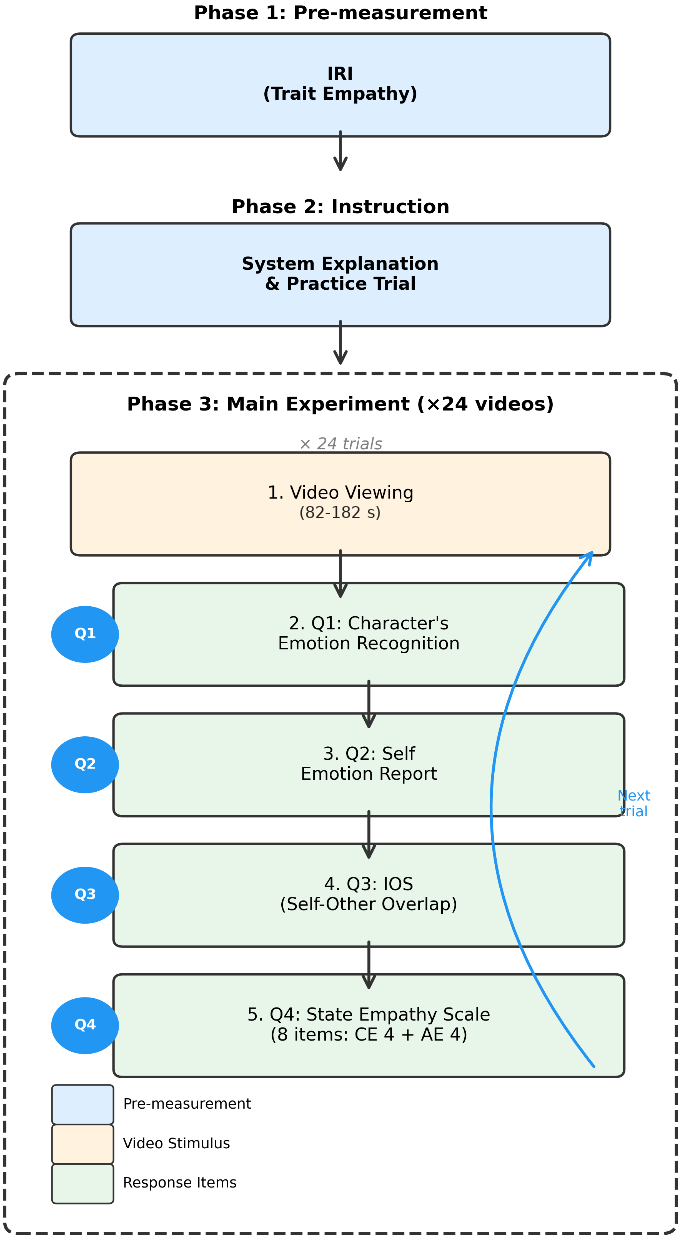
Experimental flow of a single trial
- [1] J. Decety and P. L. Jackson, “The Functional Architecture of Human Empathy,” Behavioral and Cognitive Neuroscience Reviews, Vol.3, Issue 2, pp. 71-100, 2004. https://doi.org/10.1177/1534582304267187
- [2] S. D. Preston and F. B. M. de Waal, “Empathy: Its ultimate and proximate bases,” Behavioral and Brain Sciences, Vol.25, Issue 1, pp. 1-20, 2002. https://doi.org/10.1017/S0140525X02000018
- [3] M. H. Davis, “Measuring individual differences in empathy: Evidence for a multidimensional approach,” J. of Personality and Social Psychology, Vol.44, No.1, pp. 113-126, 1983. https://doi.org/10.1037/0022-3514.44.1.113
- [4] D. Jolliffe and D. P. Farrington, “Development and validation of the Basic Empathy Scale,” J. of Adolescence, Vol.29, Issue 4, pp. 589-611, 2006. https://doi.org/10.1016/j.adolescence.2005.08.010
- [5] E. Hatfield, J. T. Cacioppo, and R. L. Rapson, “Emotional Contagion,” Cambridge University Press, 1994. https://doi.org/10.1017/CBO9781139174138
- [6] T. Singer and C. Lamm, “The Social Neuroscience of Empathy,” Annals of the New York Academy of Sciences, Vol.1156, Issue 1, pp. 81-96, 2009. https://doi.org/10.1111/j.1749-6632.2009.04418.x
- [7] J. Zaki and K. N. Ochsner, “The neuroscience of empathy: Progress, pitfalls and promise,” Nature Neuroscience, Vol.15, No.5, pp. 675-680, 2012. https://doi.org/10.1038/nn.3085
- [8] W. Fleeson and P. Gallagher, “The implications of Big Five standing for the distribution of trait manifestation in behavior: Fifteen experience-sampling studies and a meta-analysis,” J. of Personality and Social Psychology, Vol.97, No.6, pp. 1097-1114, 2009. https://doi.org/10.1037/a0016786
- [9] M. Tobari, “Predicting Empathy Arousing Process and Affective Outcome by Trait Empathy, Target Sex, and Psychological Overlap between Target and the Self,” The Japanese J. of Personality, Vol.13, Issue 2, pp. 143-155, 2005 (in Japanese). https://doi.org/10.2132/personality.13.143
- [10] L. Shen, “On a Scale of State Empathy During Message Processing,” Western J. of Communication, Vol.74, Issue 5, pp. 504-524, 2010. https://doi.org/10.1080/10570314.2010.512278
- [11] C. D. Batson, J. Fultz, and P. A. Schoenrade, “Distress and Empathy: Two Qualitatively Distinct Vicarious Emotions with Different Motivational Consequences,” J. of Personality, Vol.55, Issue 1, pp. 19-39, 1987. https://doi.org/10.1111/j.1467-6494.1987.tb00426.x
- [12] D. A. Johnson and M. J. Karcher, “Validity Evidence for a State-Specific Assessment of In-Session Counselor Empathy: The State-Empathic Concern Scale,” Measurement and Evaluation in Counseling and Development, Vol.52, Issue 4, pp. 284-296, 2019. https://doi.org/10.1080/07481756.2019.1594914
- [13] T. Levett-Jones, S. Lapkin, N. Govind, J. Pich, K. Hoffman, S. Y.-S. Jeong et al., “Measuring the impact of a ‘point of view’ disability simulation on nursing students’ empathy using the comprehensive state empathy scale,” Nurse Education Today, Vol.59, pp. 75-81, 2017. https://doi.org/10.1016/j.nedt.2017.09.007
- [14] M. Tobari and A. Oshio, “Measurement of Individual Differences in State Empathy and Examination of a Model in Japanese University Students,” Psych, Vol.5, Issue 3, pp. 928-947, 2023. https://doi.org/10.3390/psych5030061
- [15] T. Himichi, H. Osanai, T. Goto, H. Fujita, Y. Kawamura, M. H. Davis, and M. Nomura, “Development of a Japanese version of the Interpersonal Reactivity Index,” The Japanese J. of Psychology, Vol.88, Issue 1, pp. 61-71, 2017 (in Japanese). https://doi.org/10.4992/jjpsy.88.15218
- [16] S. Baron-Cohen and S. Wheelwright, “The Empathy Quotient: An Investigation of Adults with Asperger Syndrome or High Functioning Autism, and Normal Sex Differences,” J. of Autism and Developmental Disorders, Vol.34, No.2, pp. 163-175, 2004. https://doi.org/10.1023/B:JADD.0000022607.19833.00
- [17] R. L. E. P. Reniers, R. Corcoran, R. Drake, N. M. Shryane, and B. A. Völlm, “The QCAE: A Questionnaire of Cognitive and Affective Empathy,” J. of Personality Assessment, Vol.93, Issue 1, pp. 84-95, 2011. https://doi.org/10.1080/00223891.2010.528484
- [18] I. Dziobek, K. Rogers, S. Fleck, M. Bahnemann, H. R. Heekeren, O. T. Wolf, and A. Convit, “Dissociation of Cognitive and Emotional Empathy in Adults with Asperger Syndrome Using the Multifaceted Empathy Test (MET),” J. of Autism and Developmental Disorders, Vol.38, No.3, pp. 464-473, 2008. https://doi.org/10.1007/s10803-007-0486-x
- [19] P. Kanske, A. Böckler, F.-M. Trautwein, and T. Singer, “Dissecting the social brain: Introducing the EmpaToM to reveal distinct neural networks and brain-behavior relations for empathy and theory of mind,” NeuroImage, Vol.122, pp. 6-19, 2015. https://doi.org/10.1016/j.neuroimage.2015.07.082
- [20] J. Van der Graaff, W. Meeus, M. de Wied, A. van Boxtel, P. A. C. van Lier, H. M. Koot, and S. Branje, “Motor, affective and cognitive empathy in adolescence: Interrelations between facial electromyography and self-reported trait and state measures,” Cognition and Emotion, Vol.30, Issue 4, pp. 745-761, 2016. https://doi.org/10.1080/02699931.2015.1027665
- [21] Q. Zhao, D. L. Neumann, C. Yan, S. Djekic, and D. H. K. Shum, “Culture, Sex, and Group-Bias in Trait and State Empathy,” Frontiers in Psychology, Vol.12, Article No.561930, 2021. https://doi.org/10.3389/fpsyg.2021.561930
- [22] G. J. Depow and M. Inzlicht, “How Individual Differences in Empathy Predict Moments of Empathy in Everyday Life,” Personality and Social Psychology Bulletin, Vol.52, Issue 8, pp. 2529-2544, 2026. https://doi.org/10.1177/01461672251333823
- [23] K. Heyers, R. Schrödter, L. S. Pfeifer, S. Ocklenburg, O. Güntürkün, and U. Stockhorst, “(State) empathy: How context matters,” Frontiers in Psychology, Vol.16, Article No.1525517, 2025. https://doi.org/10.3389/fpsyg.2025.1525517
- [24] S. Zhang, G. Liu, and X. Lai, “Classification of Evoked Emotions Using an Artificial Neural Network Based on Single, Short-Term Physiological Signals,” J. Adv. Comput. Intell. Intell. Inform., Vol.19, No.1, pp. 118-126, 2015. https://doi.org/10.20965/jaciii.2015.p0118
- [25] X. Tao, H. Matsuo, and T. Hashimoto, “A Method of Empathy Robotics Based on Disgust,” J. Adv. Comput. Intell. Intell. Inform., Vol.26, No.6, pp. 1046-1052, 2022. https://doi.org/10.20965/jaciii.2022.p1046
- [26] J. A. Cranford, P. E. Shrout, M. Iida, E. Rafaeli, T. Yip, and N. Bolger, “A Procedure for Evaluating Sensitivity to Within-Person Change: Can Mood Measures in Diary Studies Detect Change Reliably?,” Personality and Social Psychology Bulletin, Vol.32, Issue 7, pp. 917-929, 2006. https://doi.org/10.1177/0146167206287721
- [27] M. L. Hoffman, “Empathy and Moral Development: Implications for Caring and Justice,” Cambridge University Press, 2000. https://doi.org/10.1017/CBO9780511805851
- [28] S. Baron-Cohen, A. M. Leslie, and U. Frith, “Does the autistic child have a “theory of mind”?,” Cognition, Vol.21, Issue 1, pp. 37-46, 1985. https://doi.org/10.1016/0010-0277(85)90022-8
- [29] R. F. DeVellis and C. T. Thorpe, “Scale Development: Theory and Applications,” 5th ed., Sage Publications, 2021.
- [30] L. A. Clark and D. Watson, “Constructing validity: Basic issues in objective scale development,” Psychological Assessment, Vol.7, No.3, pp. 309-319, 1995. https://doi.org/10.1037/1040-3590.7.3.309
- [31] A. Aron, E. N. Aron, and D. Smollan, “Inclusion of Other in the Self Scale and the structure of interpersonal closeness,” J. of Personality and Social Psychology, Vol.63, No.4, pp. 596-612, 1992. https://doi.org/10.1037/0022-3514.63.4.596
- [32] W. Ickes, “Empathic accuracy,” J. of Personality, Vol.61, Issue 4, pp. 587-610, 1993. https://doi.org/10.1111/j.1467-6494.1993.tb00783.x
- [33] J. Cohen, “Statistical Power Analysis for the Behavioral Sciences,” 2nd ed., Taylor & Francis, 1988. https://doi.org/10.4324/9780203771587
- [34] A. Ota, A. Nakane, S. Kumano, A. Murata, and S. Shimizu, “Validation study of empathy-eliciting video stimulus,” Proc. of the Human Communication Group (HCG) Symp. 2023, Paper A-4-3, 2023.
- [35] G. O. Boateng, T. B. Neilands, E. A. Frongillo, H. R. Melgar-Quiñonez, and S. L. Young, “Best Practices for Developing and Validating Scales for Health, Social, and Behavioral Research: A Primer,” Frontiers in Public Health, Vol.6, Article No.00149, 2018. https://doi.org/10.3389/fpubh.2018.00149
- [36] M. H. Davis and L. A. Kraus, “Personality and empathic accuracy,” W. Ickes (Ed.), “Empathic Accuracy,” Guilford Press, pp. 144-168, 1997.
- [37] A. Öhman and S. Mineka, “Fears, phobias, and preparedness: Toward an evolved module of fear and fear learning,” Psychological Review, Vol.108, No.3, pp. 483-522, 2001. https://doi.org/10.1037/0033-295X.108.3.483
This article is published under a Creative Commons Attribution-NoDerivatives 4.0 Internationa License.