
Research Paper:
Cluster-Based Learner Profiling in AI-Supported Educational Contexts: Evidence from Junior High School Students
Po-Hsin Su*,†
 , Yuan-Horng Lin*
, and Jin-Chang Hsieh**
*Department of Mathematics Education, National Taichung University of Education
No.140 Minsheng Road, West District, Taichung 403514, Taiwan
†Corresponding author
**Research Center for Testing and Assessment, National Academy for Educational Research
No.2 Sanshu Road, Sanxia District, New Taipei 237201, Taiwan

As artificial intelligence (AI) becomes increasingly embedded in educational settings, learner heterogeneity can no longer be adequately described through single-variable comparisons. This study identifies learner profiles in AI-supported educational contexts using three theoretically grounded feature dimensions: AI self-efficacy, digital literacy, and cross-disciplinary integration self-efficacy. These dimensions were operationalized using eight indicators reflecting students’ AI-related confidence, digital information-processing competence, and integrative learning readiness. Based on 8,022 valid responses from eighth-grade students in the collaborative database of the Taiwan Assessment of Student Achievement: Longitudinal Study and the Taiwan i-Generation Panel Study, available from the Survey Research Data Archive, Academia Sinica, all input indicators were normalized using Z-score scaling to construct a standardized feature space for distance estimation. A two-stage clustering procedure was adopted. First, two-step cluster analysis was performed to compare candidate solutions based on Akaike Information Criterion and Bayesian Information Criterion values; subsequently, K-means clustering was conducted with the number of clusters fixed at six to estimate the final learner profiles. The results supported six profiles: high-scoring integrated; very low-scoring; AI-moderate, digitally weak; broadly below-average; digitally adequate, AI-integration weak; and near-average balanced. The profiles showed that learner heterogeneity was not organized along a simple high–low continuum but appeared as asymmetric configurations within the multidimensional feature space. Post-clustering analyses further showed that digital-literacy indicators and AI evaluation had the largest descriptive between-profile separations, and that cluster membership differed significantly by gender. The findings extend AI literacy research from average-based comparisons to cluster-based learner profiling and provide a basis for differentiated educational support and data-driven decision-making in AI-related educational settings.
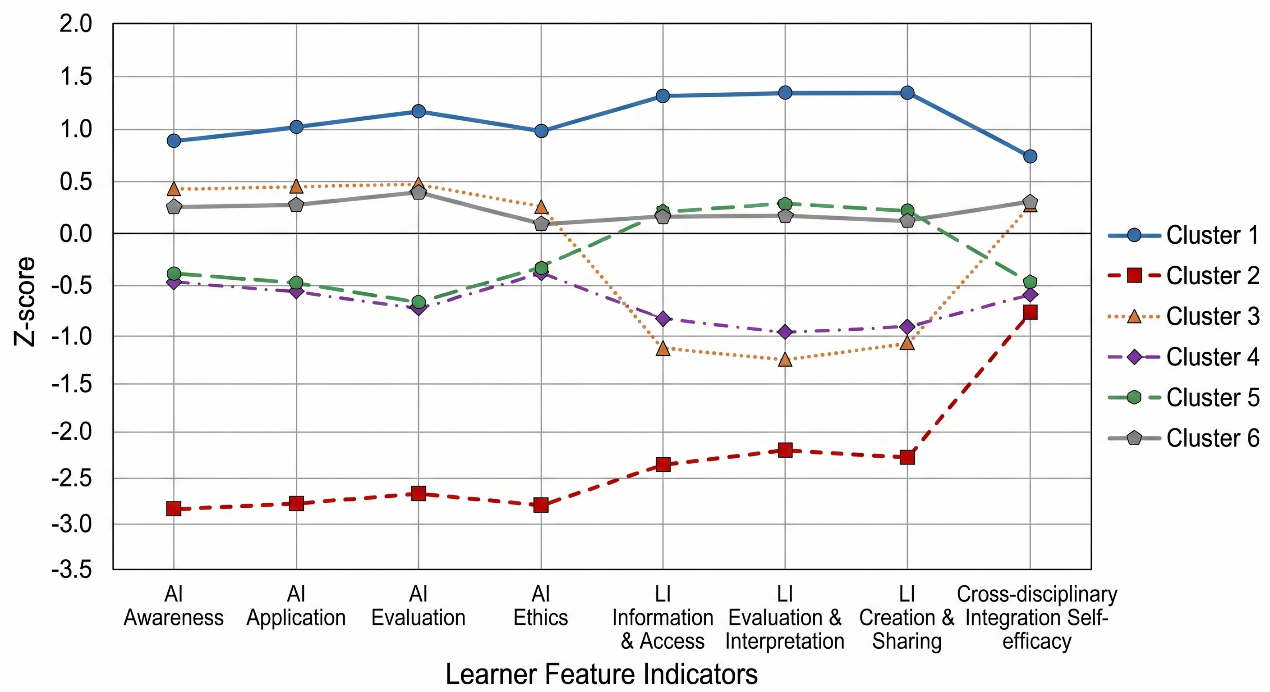
Standardized learner profiles
- [1] D. Long and B. Magerko, “What is AI literacy? Competencies and design considerations,” Proc. of the 2020 CHI Conf. on Human Factors in Computing Systems, 2020. https://doi.org/10.1145/3313831.3376727
- [2] D. T. K. Ng, J. K. L. Leung, S. K. W. Chu, and M. S. Qiao, “Conceptualizing AI literacy: An exploratory review,” Computers and Education: Artificial Intelligence, Vol.2, Article No.100041, 2021. https://doi.org/10.1016/j.caeai.2021.100041
- [3] S. Feng and A. Carolus, “Artificial intelligence literacy at school: A systematic review with a focus on psychological foundations,” Computers and Education: Artificial Intelligence, Vol.10, Article No.100551, 2026. https://doi.org/10.1016/j.caeai.2026.100551
- [4] A. Bandura, “Self-efficacy: Toward a unifying theory of behavioral change,” Psychological Review, Vol.84, No.2, pp. 191-215, 1977. https://doi.org/10.1037/0033-295X.84.2.191
- [5] Y.-Y. Wang and Y.-W. Chuang, “Artificial intelligence self-efficacy: Scale development and validation,” Education and Information Technologies, Vol.29, No.4, pp. 4785-4808, 2024. https://doi.org/10.1007/s10639-023-12015-w
- [6] R. Vuorikari, S. Kluzer, and Y. Punie, “DigComp 2.2: The digital competence framework for citizens–With new examples of knowledge, skills and attitudes,” Publications Office of the European Union, 2022. https://doi.org/10.2760/115376
- [7] C.-Y. Chang and H.-C. Kuo, “The development and validation of the digital literacy questionnaire and the evaluation of students’ digital literacy,” Education and Information Technologies, Vol.30, No.9, pp. 11549-11581, 2025. https://doi.org/10.1007/s10639-024-13216-7
- [8] S. P. Schaffer, X. Chen, X. Zhu, and W. C. Oakes, “Self-efficacy for cross-disciplinary learning in project-based teams,” J. of Engineering Education, Vol.101, No.1, pp. 82-94, 2012. https://doi.org/10.1002/j.2168-9830.2012.tb00042.x
- [9] C.-J. Huang, L.-L. Kueh, H.-W. Wang, H. Hung, and H.-H. Wang, “Assessing self-efficacy in interdisciplinary learning experiences and the effects of career-related predictors,” Higher Education, Skills and Work-Based Learning, Vol.14, No.4, pp. 782-795, 2024. https://doi.org/10.1108/HESWBL-09-2023-0259
- [10] X. Zhou, J. An, X. Zhao, and Y. Dong, “Using data mining on students’ learning features: A clustering approach for student classification,” J. Adv. Comput. Intell. Intell. Inform., Vol.20, No.7, pp. 1141-1146, 2016. https://doi.org/10.20965/jaciii.2016.p1141
- [11] Y.-H. Lin and C.-C. Chen, “Integrating fuzzy clustering and profile analysis on retrospective measurement for project-based learning,” J. Adv. Comput. Intell. Intell. Inform., Vol.29, No.4, pp. 968-976, 2025. https://doi.org/10.20965/jaciii.2025.p0968
- [12] M. Alvarez-Garcia, M. Arenas-Parra, and R. Ibar-Alonso, “Uncovering student profiles. An explainable cluster analysis approach to PISA 2022,” Computers and Education, Vol.223, Article No.105166, 2024. https://doi.org/10.1016/j.compedu.2024.105166
- [13] G. W. Milligan and M. C. Cooper, “A study of standardization of variables in cluster analysis,” J. of Classification, Vol.5, No.2, pp. 181-204, 1988. https://doi.org/10.1007/BF01897163
- [14] J. Bacher, K. Wenzig, and M. Vogler, “SPSS TwoStep Cluster–A first evaluation,” Arbeits- und Diskussionspapiere, 2004.
- [15] A. K. Jain, “Data clustering: 50 years beyond K-means,” Pattern Recognition Letters, Vol.31, No.8, pp. 651-666, 2010. https://doi.org/10.1016/j.patrec.2009.09.011
- [16] J. MacQueen, “Some methods for classification and analysis of multivariate observations,” Proc. of the 5th Berkeley Symp. on Mathematical Statistics and Probability, Vol.1, pp. 281-297, 1967.
- [17] L. Medina-Gual, L. Medina-Velázquez, and J.-L. Parejo, “A tridimensional model of AI literacy: An empirical analysis of student performance and demographic patterns in higher education,” Australasian J. of Educational Technology, Vol.41, No.5, pp. 37-55, 2025. https://doi.org/10.14742/ajet.10596
- [18] L. Medina-Gual and J.-L. Parejo, “University students’ engagement with artificial intelligence: A cluster analysis of learner profiles in AI literacy,” Technology, Knowledge and Learning, Vol.31, No.1, pp. 291-309, 2026. https://doi.org/10.1007/s10758-025-09926-7
- [19] M. Sayed, “Student progression and dropout rates using convolutional neural network: A case study of the Arab Open University,” J. Adv. Comput. Intell. Intell. Inform., Vol.28, No.3, pp. 668-678, 2024. https://doi.org/10.20965/jaciii.2024.p0668
- [20] D. Hao, “A hybrid collaborative filtering and LDA-based subject model for bidirectional employment,” J. Adv. Comput. Intell. Intell. Inform., Vol.30, No.2, pp. 566-578, 2026. https://doi.org/10.20965/jaciii.2026.p0566
- [21] J.-C. Hsieh, H.-L. S. Wang, K.-J. Chen, F.-L. Lu, P.-C. Zhao, D.-R. Li, Y.-H. Chen, and C.-I. Wu, “Taiwan assessment of student achievement: Longitudinal study (II),” National Academy for Educational Research, Project, Nos.NAER-2024-012-C-1-1-C3-01, 2024.
- [22] C.-I. Wu, H.-R. Chen, C.-W. Wu, Y.-F. Chen, L.-W. Huang, Y.-H. Chou, M.-H. Tsai, and J.-C. Hsieh, “Taiwan I-Generation Panel Study: Tracking adolescents’ developmental trajectories (2/5),” National Science and Technology Council, Project, Nos.NSTC113-2740-H-001-001-SSS, 2024.
- [23] J.-C. Hsieh, “Applying R to the Complex Sampling and Weight Estimation for a Large-Scale Assessment and Survey: The TIGPS and TASAL in I-Generation Collaborative Database,” J. of Education & Psychology, Vol.49, No.2, pp. 111-148, 2026 (in Chinese). https://doi.org/10.53106/102498852026064902004
- [24] A. González-Nucamendi, J. Noguez, L. Neri, V. Robledo-Rella, R. M. G. García-Castelán, and D. Escobar-Castillejos, “Learning Analytics to Determine Profile Dimensions of Students Associated with Their Academic Performance,” Applied Sciences, Vol.12, No.20, Article No.10560, 2022. https://doi.org/10.3390/app122010560
- [25] A. González-Nucamendi, J. Noguez, L. Neri, V. Robledo-Rella, R. M. G. García-Castelán, and D. Escobar-Castillejos, “The prediction of academic performance using engineering student’s profiles,” Computers and Electrical Engineering, Vol.93, Article No.107288, 2021. https://doi.org/10.1016/j.compeleceng.2021.107288
- [26] J. Xia, H. Wang, Q. Zhuge, and E. H.-M. Sha, “Knowledge tracing model and student profile based on clustering-neural-network,” Applied Sciences, Vol.13, No.9, Article No.5220, 2023. https://doi.org/10.3390/app13095220
- [27] L. Y. Tan, S. Hu, D. J. Yeo, and K. H. Cheong, “Artificial intelligence-enabled adaptive learning platforms: A review,” Computers and Education: Artificial Intelligence, Vol.9, Article No.100429, 2025. https://doi.org/10.1016/j.caeai.2025.100429
- [28] G. Abdelrahman, Q. Wang, and B. Nunes, “Knowledge tracing: A survey,” ACM Computing Surveys, Vol.55, No.11, Article No.224, 2023. https://doi.org/10.1145/3569576
- [29] S. Shen, Q. Liu, Z. Huang, Y. Zheng, M. Yin, M. Wang, and E. Chen, "A survey of knowledge tracing: Models, variants, and applications," IEEE Trans. on Learning Technologies, Vol.17, pp.1898-1919, 2024. https://doi.org/10.1109/TLT.2024.3383325
This article is published under a Creative Commons Attribution-NoDerivatives 4.0 Internationa License.