
Research Paper:
Evaluation of Visuospatial Ability in Elderly Adults Using Eye Tracking and Virtual Reality Content
Fumiya Kinoshita*,†
 , Kansuke Kawaguchi**, and Tomiko Takeuchi**
*Graduate School of Engineering, Mie University
1577 Kurimamachiya-cho, Tsu, Mie 514-8507, Japan
†Corresponding author
**Faculty of Nursing, Toyama Prefectural University
2-2-78 Nishi-nagaeda, Toyama, Toyama 930-0975, Japan

Early detection of mild cognitive impairment (MCI) is essential for preventing progression to dementia. Conventional neuropsychological tests, such as cube copying and clock drawing, are widely used to assess visuospatial and executive functions; however, these assessments rely largely on qualitative observation by clinicians, which may limit their objectivity. Therefore, a quantitative method for objectively evaluating visuospatial function is desirable. This study develops and validates a virtual reality (VR)-based assessment using eye-tracking that enables objective differentiation between healthy elderly adults and individuals suspected of having MCI. VR content presenting periodic depth stimuli was developed, and gaze behavior was recorded using a head-mounted display equipped with an eye-tracking system. Changes in interpupillary distance induced by depth perception were analyzed to derive quantitative indices, including the coefficient of determination (R2) obtained using sinusoidal fitting and spectral power in the frequency domain. Experiments were conducted with elderly participants consisting of a healthy group and individuals suspected of having MCI, as determined based on the Japanese version of the Montreal Cognitive Assessment. Significant differences were observed between the groups (p=0.026), and linear discriminant analysis achieved accurate classification, with no misclassification in the healthy group and two misclassifications in the suspected MCI group. These findings indicate that the proposed method enables objective and quantitative evaluation of visuospatial function and may contribute to the early detection and screening of MCI.
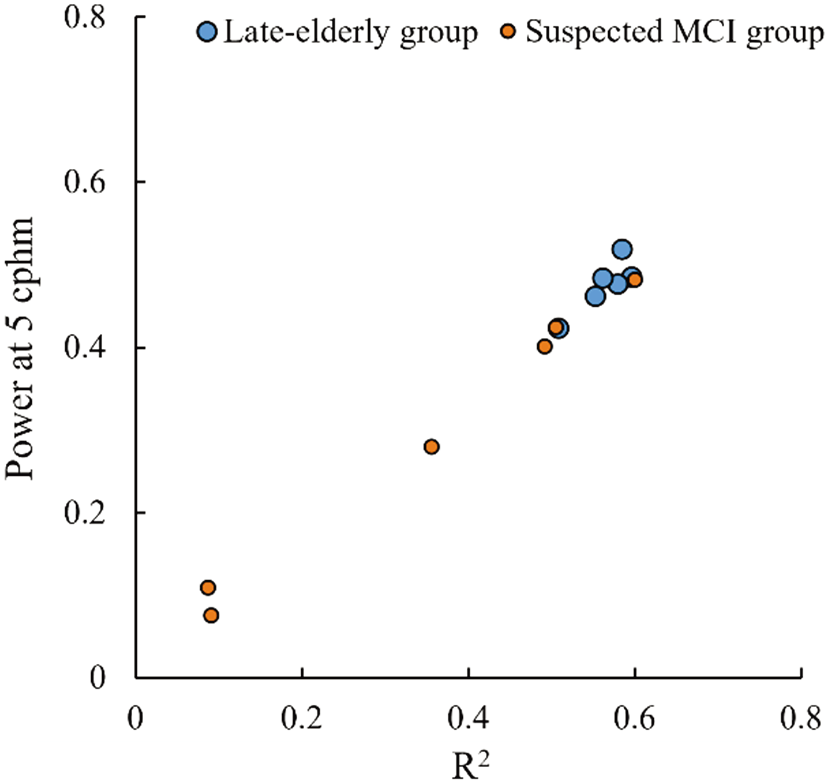
VR-based classification of healthy and MCI-suspected groups
- [1] R. C. Petersen, G. E. Smith, S. C. Waring, R. J. Ivnik, E. G. Tangalos, and E. Kokmen, “Mild cognitive impairment: Clinical characterization and outcome,” Archives of Neurology, Vol.56, No.3, pp. 303-308, 1999. https://doi.org/10.1001/archneur.56.3.303
- [2] H. Suzuki, M. Yasunaga, and T. Naganuma, “Validation of the Japanese version of the Montreal Cognitive Assessment to evaluate the time course changes of cognitive function: A longitudinal study with mild cognitive impairment and early-stage Alzheimer’s disease,” Japanese J. of Geriatric Psychiatry, Vol.22, No.2, pp. 211-218, 2011 (in Japanese).
- [3] K. Nakajima, S. Shimohama, H. Tomimoto, M. Mimura, and T. Arai, “Dementia Disease Treatment Handbook (2nd ed.),” Igaku-Shoin, 2021.
- [4] M. F. Mendez, and J. L. Cummings, “Dementia: A Clinical Approach (3rd ed.),” Butterworth-Heinemann, 2003.
- [5] M. A. Goodale and A. D. Milner, “Separate visual pathways for perception and action,” Trends in Neurosciences, Vol.15, No.3, pp. 20-25, 1992. https://doi.org/10.1016/0166-2236(92)90344-8
- [6] S. N. Thiyagesh, T. F. D. Farrow, R. W. Parks, H. Accosta-Mesa, C. Young, I. D. Wilkinson, M. D. Hunter, and P. W. R. Woodruff, “The neural basis of visuospatial perception in Alzheimer’s disease and healthy elderly comparison subjects: An fMRI study,” Psychiatry Research: Neuroimaging, Vol.172, No.2, pp. 109-116, 2009. https://doi.org/10.1016/j.pscychresns.2008.11.002
- [7] F. Kinoshita and H. Takada, “A study on the development of VR content for quantitative evaluation of impaired visuospatial ability,” Proc. of the 24th Int. Conf. on Human–Computer Interaction, Lecture Notes in Computer Science, Vol.13521, pp. 440-450, 2022. https://doi.org/10.1007/978-3-031-17902-0_31
- [8] T. Ohara, K. Kawaguchi, T. Takeuchi, and F. Kinoshita, “Visuospatial ability of elderly using head-mounted display with gaze measurement function,” Proc. of the 25th Int. Conf. on Human–Computer Interaction, Lecture Notes in Computer Science, Vol.14021, pp. 81-90, 2023. https://doi.org/10.1007/978-3-031-35897-5_6
- [9] T. Ohara, K. Kawaguchi, T. Takeuchi, and F. Kinoshita, “Study on the quantitative evaluation of convergence-divergence motion using head-mounted display with gaze measurement function,” Proc. of the 18th Int. Conf. on Computer Science & Education, Communications in Computer and Information Science, Vol.2025, pp. 277-285, 2023. https://doi.org/10.1007/978-981-97-0737-9_25
- [10] H. Togawa, “Information Processing Introduction Course 7: Numerical Calculation,” Iwanami Shoten, 1991.
- [11] O. Uchida, “Easy-to-Understand Multivariate Analysis with Excel (2nd ed.),” Tokyo Tosho, 2000.
- [12] Z. S. Nasreddine, N. A. Phillips, V. Bédirian, S. Charbonneau, V. Whitehead, I. Collin, J. L. Cummings, and H. Chertkow, “The Montreal cognitive assessment, MoCA: A brief screening tool for mild cognitive impairment,” J. of the American Geriatrics Society, Vol.53, No.4, pp. 695-699, 2005. https://doi.org/10.1111/j.1532-5415.2005.53221.x
- [13] H. Suzuki, “Points of attention regarding implementation and interpretation related to Japanese version of the Montreal Cognitive Assessment (MoCA-J),” Japanese J. of Geriatric Psychiatry, Vol.29, No.11, pp. 1145-1149, 2018 (in Japanese).
- [14] S. P. Chen, J. Bhattacharya, and S. Pershing, “Association of vision loss with cognition in older adults,” JAMA Ophthalmology, Vol.135, No.9, pp. 963-970, 2017. https://doi.org/10.1001/jamaophthalmol.2017.2838
This article is published under a Creative Commons Attribution-NoDerivatives 4.0 Internationa License.