
Research Paper:
Data-Driven Portfolio Optimization Using a Predict-Then-Optimize Framework
Yi Wang†
 and Takashi Hasuike
Graduate School of Science and Engineering, Waseda University
3-4-1 Okubo, Shinjuku-ku, Tokyo 169-8555, Japan
†Corresponding author

Effective portfolio diversification remains a central challenge in quantitative asset management. In this study, we propose a data-driven framework based on the predict-then-optimize (PO) paradigm, which combines return forecasting with portfolio allocation in a sequential manner. The forecasting module employs DLinear, a lightweight deep learning model, to capture temporal patterns in historical asset returns. Based on the predicted returns, a portfolio allocation strategy is constructed by optimizing the Sharpe ratio, allowing the model to generate adaptive portfolio weights under changing market conditions. This PO-based framework provides a practical way to connect predictive modeling with downstream decision-making. Empirical results across three asset universes demonstrate that the proposed approach achieves competitive performance under different settings, indicating its potential applicability in real-world portfolio management.
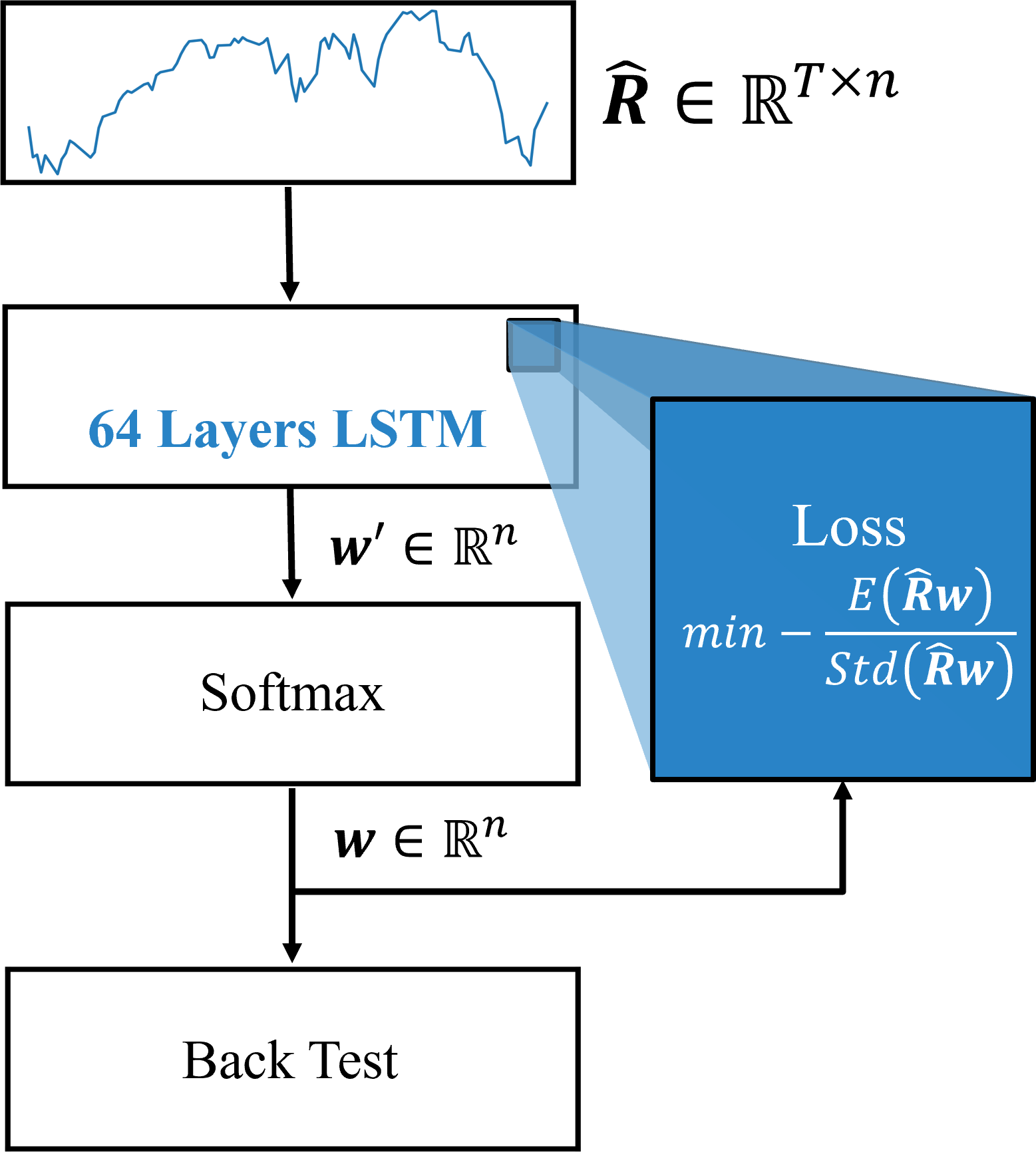
The neural network in allocation step
- [1] H. Markowitz, “Portfolio selection,” The J. of Finance, Vol.7, No.1, pp. 77-91, 1952. https://doi.org/10.2307/2975974
- [2] W. F. Sharpe, “Mutual fund performance,” The J. of Business, Vol.39, No.S1, pp. 119-138, 1966. https://doi.org/10.1086/294846
- [3] W. F. Sharpe, “Capital asset prices: A theory of market equilibrium under conditions of risk,” The J. of Finance, Vol.19, No.3, pp. 425-442, 1964. https://doi.org/10.2307/2977928
- [4] F. Black and R. B. Litterman, “Asset allocation: Combining investor views with market equilibrium,” The J. of Fixed Income, Tech. Rep.2, 1991. https://doi.org/10.3905/jfi.1991.408013
- [5] I. Karatzas and R. Fernholz, “Stochastic portfolio theory: An overview,” A. Bensoussan and Q. Zhang (Eds.), “Handbook of Numerical Analysis,” Vol.15, pp. 89-167, 2009. https://doi.org/10.1016/S1570-8659(08)00003-3
- [6] X. Hou, K. Wang, J. Zhang, and Z. Wei, “An enriched time-series forecasting framework for long-short portfolio strategy,” IEEE Access, Vol.8, pp. 31992-32002, 2020. https://doi.org/10.1109/access.2020.2973037
- [7] I. S. Chaudhry, F. Farooq, and A. Mushtaq, “Factors affecting portfolio investment in Pakistan: Evidence from time series analysis,” Pakistan Economic and Social Review, pp. 141-158, 2014.
- [8] H. K. Choi, “Stock price correlation coefficient prediction with arima-lstm hybrid model,” arXiv:1808.01560, 2018. https://doi.org/10.48550/arXiv.1808.01560
- [9] W. Wang, W. Li, N. Zhang, and K. Liu, “Portfolio formation with preselection using deep learning from long-term financial data,” Expert Systems with Applications, Vol. 143, Article No.113042, 2020. https://doi.org/10.1016/j.eswa.2019.113042
- [10] Z. Zhang, S. Zohren, and S. Roberts, “Deep learning for portfolio optimization,” The J. of Financial Data Science, Vol.2, No.4, pp. 8-20, 2020. https://doi.org/10.3905/jfds.2020.1.042
- [11] A. Filos, “Reinforcement learning for portfolio management,” arXiv:1909.09571, 2019. https://doi.org/10.48550/arXiv.1909.09571
- [12] Z. Jiang, D. Xu, and J. Liang, “A deep reinforcement learning framework for the financial portfolio management problem,” arXiv:1706.10059, 2017.
- [13] S. Pyo and J. Lee, “Exploiting the low-risk anomaly using machine learning to enhance the Black–Litterman framework: Evidence from South Korea,” Pacific-Basin Finance J., Vol.51, pp. 1-12, 2018. https://doi.org/10.1016/j.pacfin.2018.06.002
- [14] J. Shi, M. Jain, and G. Narasimhan, “Time series forecasting (TSF) using various deep learning models,” arXiv:2204.11115, 2022. https://doi.org/10.48550/arXiv.2204.11115
- [15] A. N. Elmachtoub and P. Grigas, “Smart predict, then optimize: Decision-focused learning using label-aware losses,” Management Science, Vol.67, No.9, pp. 5752-5771, 2021.
- [16] J. Mandi, J. Kotary, S. Berden, M. Mulamba, V. Bucarey, T. Guns, and F. Fioretto, “Decision-focused learning: Foundations, state of the art, benchmark and future opportunities,” J. of Artificial Intelligence Research, Vol.80, pp. 1623-1701, 2024. https://doi.org/10.1613/jair.1.15320
- [17] A. Vaswani et al., “Attention is all you need,” Advances in Neural Information Processing Systems, Vol.30, 2017.
- [18] H. Zhou, S. Zhang, J. Peng, S. Zhang, J. Li, H. Xiong, and W. Zhang, “Informer: Beyond efficient transformer for long sequence time-series forecasting,” Proc. of the AAAI Conf. on Artificial Intelligence, Vol.35, No.12, pp. 11106-11115, 2021. https://doi.org/10.1609/aaai.v35i12.17325
- [19] H. Wu et al., “Autoformer: Decomposition transformers with auto-correlation for long-term series forecasting,” Advances in Neural Information Processing Systems, Vol.34, pp. 22419-22430, 2021.
- [20] A. Zeng, M. Chen, L. Zhang, and Q. Xu, “Are transformers effective for time series forecasting?,” Proc. of the AAAI Conf. on Artificial Intelligence, Vol.37, No.9, pp. 11121-11128, 2023. https://doi.org/10.1609/aaai.v37i9.26317
- [21] S. Hochreiter and J. Schmidhuber, “Long short-term memory,” Neural Computation, Vol.9, No.8, pp. 1735-1780, 1997. https://doi.org/10.1162/neco.1997.9.8.1735
This article is published under a Creative Commons Attribution-NoDerivatives 4.0 Internationa License.