
Research Paper:
Enryo as Considerate Action-Refraining: Human Attribution of Intention to Social Agents
Sho Kawai*, Yotaro Fuse**
 , Noboru Takagi**, Tatsuo Motoyoshi**, and Hironobu Takano**
*Graduate School of Intelligent Robotics Engineering, Toyama Prefectural University
5180 Kurokawa, Imizu, Toyama 939-0398, Japan
**Toyama Prefectural University
5180 Kurokawa, Imizu, Toyama 939-0398, Japan

This study investigates human impressions of autonomous agents that refrain from action. The increasing frequency of human–agent interactions has increased the demand for cooperative human–agent behavior. In human communication, cooperative behavior is frequently regarded as refraining from action to consider the requirements or desires of others (referred to as enryo in Japanese). However, enryo behavior is rarely investigated in human–agent interaction experiments. Investigating how people react to an agent refraining from action and observing actions of the agents would advance the society toward coexistence of humans and autonomous agents. Here, we demonstrate that humans indeed perceive enryo demonstrations in refraining-from-action agents; moreover, this behavior renders an agent more anthropomorphic and likeable than a non-considerate agent. Enryo impressions are also associated with increased human proactivity, suggesting that enryo functions as a social cue that encourages initiative actions by humans. Therefore, incorporating enryo-like behavior in agents may enhance the smoothness and cooperativeness of human–agent interactions.
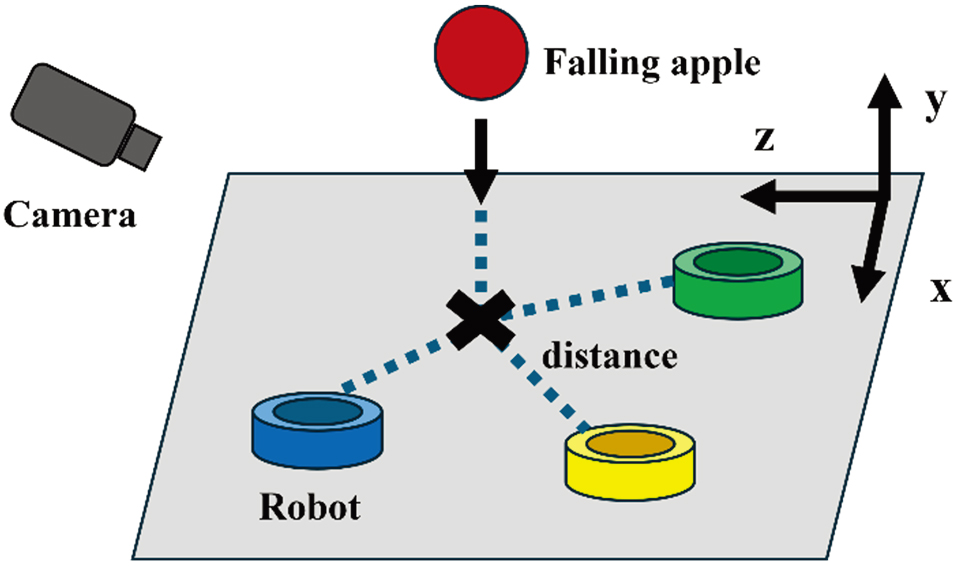
Human―agent apple-catching task
- [1] I. Leite, C. Martinho, and A. Paiva, “Social robots for long-term interaction: A survey,” Int. J. Soc. Robot., Vol.5, pp. 291-308, 2013. https://doi.org/10.1007/s12369-013-0178-y
- [2] T. B. Sheridan, “A review of recent research in social robotics,” Curr. Opin. Psychol., Vol.36, pp. 7-12, 2020. https://doi.org/10.1016/j.copsyc.2020.01.003
- [3] Y. Shoham, “Agent-oriented programming,” Artif. Intell., Vol.60, No.1, pp. 51-92, 1993. https://doi.org/10.1016/0004-3702(93)90034-9
- [4] A. K. Pandey and R. Gelin, “A mass-produced sociable humanoid robot: Pepper: The first machine of its kind,” IEEE Robot. Autom. Mag., Vol.25, No.3, pp. 40-48, 2018. https://doi.org/10.1109/MRA.2018.2833157
- [5] K. Keeling, P. McGoldrick, and S. Beatty, “Avatars as salespeople: Communication style, trust, and intentions,” J. Bus. Res., Vol.63, No.8, pp. 793-800, 2010. https://doi.org/10.1016/j.jbusres.2008.12.015
- [6] W. M. Lim, S. Kumar, S. Verma, and R. Chaturvedi, “Alexa, what do we know about conversational commerce? Insights from a systematic literature review,” Psychol. Mark., Vol.39, No.6, pp. 1129-1155, 2022. https://doi.org/10.1002/mar.21654
- [7] S. Matsubayashi, K. Miwa, H. Terai, A. Shimojo, and Y. Ninomiya, “What is the cooperative behavior of moving in shared spaces?,” Proc. Annu. Meet. Cogn. Sci. Soc., Vol.43, 2021. https://escholarship.org/uc/item/32s2n125 [Accessed July 16, 2025]
- [8] M. C. Buehler and T. H. Weisswange, “Theory of mind based communication for human agent cooperation,” Proc. 2020 IEEE Int. Conf. Hum.-Mach. Sys. (ICHMS), 2020. https://doi.org/10.1109/ICHMS49158.2020.9209472
- [9] Z. Sun and C. Firestone, “Optimism and pessimism in the predictive brain,” Trends Cogn. Sci., Vol.24, No.9, pp. 683-685, 2020. https://doi.org/10.1016/j.tics.2020.06.001
- [10] P. A. Hancock, D. R. Billings, K. E. Schaefer, J. Y. C. Chen, E. J. De Visser, and R. Parasuraman, “A meta-analysis of factors affecting trust in human-robot interaction,” Hum. Factors J. Hum. Factors Ergon. Soc., Vol.53, No.5, pp. 517-527, 2011. https://doi.org/10.1177/0018720811417254
- [11] A. van Wissen, J. van Diggelen, and V. Dignum, “The effects of cooperative agent behavior on human cooperativeness,” Proc. of 8th Int. Conf. Auton. Agents Multi Agent Syst. (AAMAS’09), Vol.2, pp. 1179-1180, 2009. https://doi.org/10.65109/ulru2121
- [12] B. Reeves and C. Nass, “The Media Equation: How People Treat Computers, Television, and New Media Like Real People,” Cambridge University Press, 1996.
- [13] F. Heider and M. Simmel, “An experimental study of apparent behavior,” Am. J. Psychol., Vol.57, No.2, pp. 243-259, 1944. https://doi.org/10.2307/1416950
- [14] D. C. Dennett, “The Intentional Stance,” MIT Press, 1989.
- [15] K. Terada and A. Ito, “Can a robot deceive humans?,” 5th ACM/IEEE Int. Conf. Hum.-Robot Interact. (HRI), pp. 191-192, 2010. https://doi.org/10.1109/HRI.2010.5453201
- [16] S. Ishii, “Enryo-sasshi communication: A key to understanding Japanese interpersonal relations,” Cross Curr., Vol.11, No.1, pp. 49-58, 1984.
- [17] Y. Fuse, R. Nomoto, E. Ayedoun, and M. Tokumaru, “Impression of robots adaptively refraining from actions in human-robot cooperative scenario,” Proc. Joint 12th Int. Conf. Soft Comput. Intell. Syst. 23rd Int. Symp. Adv. Intell. Syst. (SCIS&ISIS), 2022. https://doi.org/10.1109/SCISISIS55246.2022.10001993
- [18] S. Kawai et al., “Impressions of agents encouraging humans to adopt intentional stance by refraining from action,” Proc. Joint 13th Int. Conf. Soft Comput. Intell. Syst. 25th Int. Symp. Adv. Intell. Syst. (SCIS&ISIS), 2024. https://doi.org/10.1109/SCISISIS61014.2024.10759893
- [19] M. M. E. Van Pinxteren, M. Pluymaekers, and J. G. A. M. Lemmink, “Human-like communication in conversational agents: A literature review and research agenda,” J. Serv. Manag., Vol.31, No.2, pp. 203-225, 2020. https://doi.org/10.1108/JOSM-06-2019-0175
- [20] X. Zhao, W. You, Z. Zheng, S. Shi, Y. Lu, and L. Sun, “How do consumers trust and accept AI agents? An extended theoretical framework and empirical evidence,” Behav. Sci., Vol.15, No.3, Article No.337, 2025. https://doi.org/10.3390/bs15030337
- [21] S. Bae, T. Jung, J. Cho, and O. Kwon, “Effects of meta-human characteristics on user acceptance: From the perspective of uncanny valley theory,” Behav. Inf. Technol., Vol.44, No.4, pp. 731-748, 2025. https://doi.org/10.1080/0144929X.2024.2338408
- [22] S. Thellman, M. de Graaf, and T. Ziemke, “Mental state attribution to robots: A systematic review of conceptions, methods, and findings,” ACM Trans. Hum.-Robot Interact., Vol.11, No.4, Article No.41, 2022. https://doi.org/10.1145/3526112
- [23] S. Marchesi, D. Ghiglino, F. Ciardo, J. Perez-Osorio, E. Baykara, and A. Wykowska, “Do we adopt the intentional stance toward humanoid robots?,” Front. Psychol., Vol.10, Article No.450, 2019. https://doi.org/10.3389/fpsyg.2019.00450
- [24] T. Ziemke, “Understanding social robots: Attribution of intentional agency to artificial and biological bodies,” Artif. Life, Vol.29, No.3, pp. 351-366, 2023. https://doi.org/10.1162/artl_a_00404
- [25] B. F. Malle, M. Scheutz, J. Forlizzi, and J. Voiklis, “Which robot am I thinking about? The impact of action and appearance on people’s evaluations of a moral robot,” 11th ACM/IEEE Int. Conf. Hum.-Robot Interact. (HRI), pp. 125-132, 2016. https://doi.org/10.1109/HRI.2016.7451743
- [26] Y. Cheng and Y. Wang, “Evaluating the effect of outfit on personality perception in virtual characters,” Virtual Worlds, Vol.3, No.1, pp. 21-39, 2024. https://doi.org/10.3390/virtualworlds3010002
- [27] Y. Song, A. Luximon, and Y. Luximon, “The effect of facial features on facial anthropomorphic trustworthiness in social robots,” Appl. Ergon., Vol.94, Article No.103420, 2021. https://doi.org/10.1016/j.apergo.2021.103420
- [28] K. Berns and A. Ashok, “‘You scare me’: The effects of humanoid robot appearance, emotion, and interaction skills on uncanny valley phenomenon,” Actuators, Vol.13, No.10, Article No.419, 2024. https://doi.org/10.3390/act13100419
- [29] S. S. Kwak, “The impact of the robot appearance types on social interaction with a robot and service evaluation of a robot,” Arch. Des. Res., Vol.27, No.2, pp. 81-93, 2014. https://doi.org/10.15187/adr.2014.05.110.2.81
- [30] T. Baur, I. Damian, F. Lingenfelser, J. Wagner, and E. André, “NovA: Automated analysis of nonverbal signals in social interactions,” Proc. 4th Int. Work. Hum. Behav. Underst., pp. 160-171, 2013. https://doi.org/10.1007/978-3-319-02714-2_14
- [31] S. Loth and J. P. De Ruiter, “Editorial: Understanding social signals: How do we recognize the intentions of others?,” Front. Psychol., Vol.7, Article No.281, 2016. https://doi.org/10.3389/fpsyg.2016.00281
- [32] J. K. Burgoon, X. Wang, X. Chen, S. J. Pentland, and N. E. Dunbar, “Nonverbal behaviors ‘speak’ relational messages of dominance, trust, and composure,” Front. Psychol., Vol.12, Article No.624177, 2021. https://doi.org/10.3389/fpsyg.2021.624177
- [33] D. S. Arnault, “Help-seeking and social support in Japanese sojourners,” West. J. Nurs. Res., Vol.24, No.3, pp. 295-306, 2002. https://doi.org/10.1177/01939450222045914
- [34] Y. Miike, “Japanese enryo-sasshi communication and the psychology of amae: Reconsideration and reconceptualization,” Keio Commun. Rev., No.25, pp.93-115, 2003.
- [35] C. D. Dunn, “Speaking politely, kindly, and beautifully: Ideologies of politeness in Japanese business etiquette training,” Multilingua, Vol.32, No.2, pp. 225-245, 2013. https://doi.org/10.1515/multi-2013-0011
- [36] B. Pizziconi, “The lexical mapping of politeness in British English and Japanese,” J. Politeness Res., Vol.3, No.2, pp. 207-241, 2007. https://doi.org/10.1515/PR.2007.010
- [37] T. Sugiyama and M. Kanoh, “Investigating emotional impressions in robots using clothing colors,” J. Adv. Comput. Intell. Intell. Inform., Vol.28, No.1, pp. 79-85, 2024. https://doi.org/10.20965/jaciii.2024.p0079
- [38] A. Corrales-Paredes, D. O. Sanz, M.-J. Terrón-López, and V. Egido-García, “User experience design for social robots: A case study in integrating embodiment,” Sensors, Vol.23, No.11, Article No.5274, 2023. https://doi.org/10.3390/s23115274
- [39] A. Hanson, N. D. Starr, C. Emnett, R. Wen, B. F. Malle, and T. Williams, “The power of advice: Differential blame for human and robot advisors and deciders in a moral advising context,” Proc. 2024 ACM/IEEE Int. Conf. Hum.-Robot Interact., pp. 240-249, 2024. https://doi.org/10.1145/3610977.3634942
- [40] R. Kühne and J. Peter, “Anthropomorphism in human–robot interactions: A multidimensional conceptualization,” Commun. Theory, Vol.33, No.1, pp. 42-52, 2023. https://doi.org/10.1093/ct/qtac020
- [41] J. García-Martínez, J. J. Gamboa-Montero, J. C. Castillo, and Á. Castro-González, “Analyzing the impact of responding to joint attention on the user perception of the robot in human–robot interaction,” Biomimetics, Vol.9, No.12, Article No.769, 2024. https://doi.org/10.3390/biomimetics9120769
- [42] K. Kobayashi and S. Yamada, “Motion overlap for a mobile robot to express its mind,” J. Adv. Comput. Intell. Intell. Inform., Vol.11, No.8, pp. 964-971, 2007. https://doi.org/10.20965/jaciii.2007.p0964
- [43] C. Bartneck, D. Kulić, E. Croft, and S. Zoghbi, “Measurement instruments for the anthropomorphism, animacy, likeability, perceived intelligence, and perceived safety of robots,” Int. J. Soc. Robot., Vol.1, pp. 71-81, 2009. https://doi.org/10.1007/s12369-008-0001-3
This article is published under a Creative Commons Attribution-NoDerivatives 4.0 Internationa License.