
Research Paper:
An Intelligent Control Strategy Based on Control of Three Key Process Variables for Gas Boiler Power Generation Process
Xinjian Zhang*1,*2,*3,*4, Fan Yin*1,*2,*3, Fusheng Peng*1,*2,*3
 , Jie Hu*1,*2,*3,†
, and Jundong Wu*1,*2,*3
, Jie Hu*1,*2,*3,†
, and Jundong Wu*1,*2,*3
*1School of Artificial Intelligence and Automation, China University of Geosciences (Wuhan)
No.388 Lumo Road, Hongshan District, Wuhan 430074, China
*2Hubei Key Laboratory of Advanced Control and Intelligent Automation for Complex Systems
No.388 Lumo Road, Hongshan District, Wuhan 430074, China
*3Engineering Research Center of Intelligent Technology for Geo-Exploration, Ministry of Education
No.388 Lumo Road, Hongshan District, Wuhan 430074, China
*4Loudi Valin V-Cloud Digital Technology Co., Ltd.
Room 1509, 15th Floor, Shuangling Building, No.1005 North Gangui Road, Louxing District, Loudi 417009, China
†Corresponding author

As the emphasis on energy efficiency and environmental protection grows, an intelligent control strategy for the power generation process of gas boilers has become a key approach to optimizing industrial production. This paper presents an intelligent control strategy for a 150 MW ultra-high temperature subcritical gas boiler’s power generation process. The strategy aims to address the issue of frequent manual adjustments to the mixed gas and attemperating water valves due to fuel instability. The proposed strategy achieves stable control of the power generation process and dynamic regulation of the power generation load. It does so by monitoring key operating parameters of the gas boiler in real time, designing an intelligent control strategy that uses three key process variables (main steam temperature, gas equivalent, and attemperating water valve opening degree) as controlled parameters, and implementing expert rule-based control. Operational results demonstrate that this control strategy effectively stabilizes the main steam temperature within the specified process range and enables dynamic regulation of the power generation load. With a system utilization rate exceeding 90% and a reduction in standard coal consumption from 299.8 g/kWh under manual control to 297 g/kWh under automatic control, this strategy effectively stabilizes the power generation process. It significantly improves combustion efficiency, reduces energy consumption, and mitigates environmental pollution. Thus, it has promising practical application prospects.
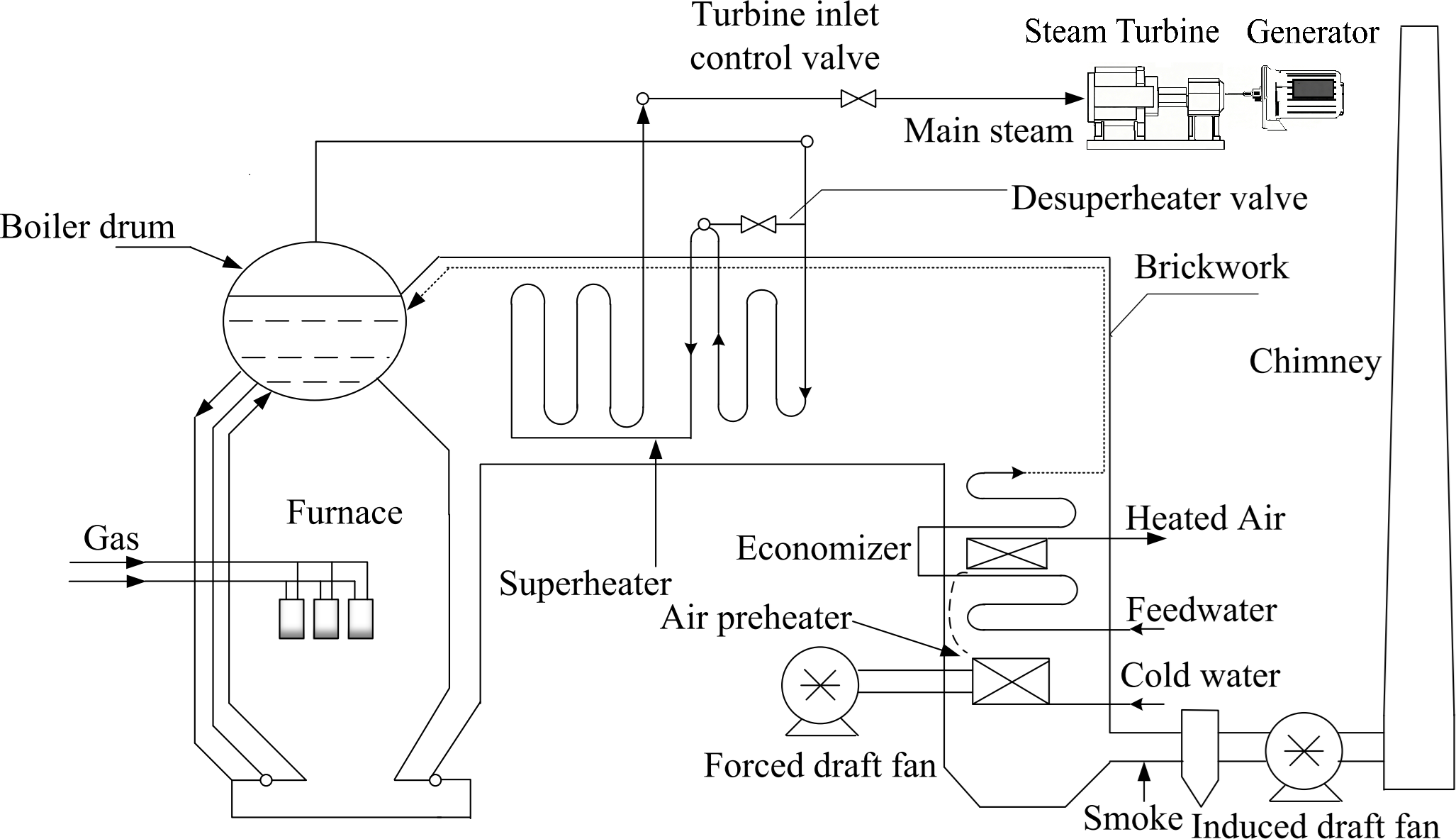
Process flow diagram
- [1] S. Xie, Y. Hua, S. Lu, and X. Li, “A novel spatio-temporal adaptive prediction modeling strategy for industrial production process,” IEEE Trans. Instrum. Meas., Vol.72, Article No.2507011, 2023. https://doi.org/10.1109/TIM.2023.3246514
- [2] S. Sgouridis, M. Ali, A. Sleptchenko, A. Bouabid, and G. Ospina, “Aluminum smelters in the energy transition: Optimal configuration and operation for renewable energy integration in high insolation regions,” Renew. Energy, Vol.180, pp. 937-953, 2021. https://doi.org/10.1016/j.renene.2021.08.080
- [3] F. Hong, Y. Zhao, W. Ji, and Vasbieva, “A feature-state observer and suppression control for generation-side low-frequency oscillation of thermal power units,” Applied Energy, Vol.354, Article No.122179, 2024. https://doi.org/10.1016/j.apenergy.2023.122179
- [4] J. Hu, M. Wu, and W. Pedrycz, “Adaptive weighted broad echo state learning system-based dynamic modeling of carbon consumption in sintering process,” IEEE Trans. on Neural Networks and Learning Systems, Vol.36, No.7, pp. 12066-12075, 2025. https://doi.org/10.1109/TNNLS.2024.3491101
- [5] J. Hu, J. Liu, M. Wu, and W. Pedrycz, “A framework for time-series dynamic modeling of carbon consumption in sintering process,” IEEE Trans. on Systems, Man, and Cybernetics: Systems, Vol.55, No.10, pp. 7369-7378, 2025. https://doi.org/10.1109/TSMC.2025.3583084
- [6] J. Hu, M. Wu, W. Cao, and W. Pedrycz, “Dynamic modeling framework based on automatic identification of operating conditions for sintering carbon consumption prediction,” IEEE Trans. on Industrial Electronics, Vol.71, No.3, pp. 3133-3141, 2024. https://doi.org/10.1109/TIE.2023.3270514
- [7] J. Hu, H. Li, H. Li, M. Wu, W. Cao, and W. Pedrycz, “Relevance vector machine with hybrid kernel-based soft sensor via data augmentation for incomplete output data in sintering process,” Control Engineering Practice, Vol.145, Article No.105850, 2024. https://doi.org/10.1016/j.conengprac.2024.105850
- [8] K. Kravtsov and V. Kukartsev, “Algorithmic optimization of coal-fired boilers using energy consumption models,” 2025 24th Int. Symp. INFOTEH-JAHORINA (INFOTEH), 2025. https://doi.org/10.1109/INFOTEH64129.2025.10959271
- [9] M. Jiang, H. Yu, M. Jin, I. Nakamoto, G. T. Tang, and Y. Guo, “Research on boiler energy saving technology based on Internet of Things data,” J. Adv. Comput. Intell. Intell. Inform, Vol.28, No.2, pp. 296-302, 2024. https://doi.org/10.20965/jaciii.2024.p0296
- [10] O. Maslak, M. Maslak, N. Grishko, Y. Yakovenko, and A. Savielova, “Formation of metallurgy industry development scenarios based on energy efficiency and digitalization of production,” 2023 IEEE 4th KhPI Week on Advanced Technology (KhPIWeek), 2023. https://doi.org/10.1109/KhPIWeek61412.2023.10312839
- [11] L. Yuan, “The impact and cause analysis of low-nitrogen burner retrofit on boiler fouling in a 670 MW unit,” China Equipment Engineering, Vol.20, pp. 197-199, 2024.
- [12] L. Qiu, “Fault prediction and diagnosis of boiler combustion systems in thermal power plants based on artificial intelligence,” Modern Manufacturing Technology and Equipment, Vol.60, No.10, pp. 131-133, 2024.
- [13] J. Liu and Z. Wang, “Optimization of steam temperature regulation for ‘W’ type subcritical coal-fired boilers,” Energy Technology, Vol.19, No.1, pp. 56-60, 2021.
- [14] G. Zhu, “Optimization of combustion control scheme to solve boiler safety operation issues,” Chemical Engineering Safety and Environment, Vol.36, No.12, pp. 71-73, 2023.
- [15] J. Bian, B. Xie, and H. Wu, “Boiler flame combustion state recognition based on multi-feature fusion and WOA-SVM,” China Special Equipment Safety, Vol.40, No.9, pp. 13-18, 2024.
- [16] J. Sun and W. Zhang, “Fuzzy self-optimizing peak regulation control for combustion temperature of coal-fired hot water boilers in power plants,” Resources Conservation and Environmental Protection, No.4, pp. 118-122, 2025.
- [17] J. Song and Y. Feng, “Neural network-based modeling of boiler combustion control system for power generation,” 2023 IEEE 6th Int. Conf. on Knowledge Innovation and Invention (ICKII), pp. 503-505, 2023. https://doi.org/10.1109/ICKII58656.2023.10332672
- [18] Y. Zhou, “Design and application of automatic control system for main steam temperature of gas boilers,” Metallurgical Industry Automation, Vol.43, No.2, pp. 73-76, 2019.
- [19] L. Yuan, Z. Li, and D. Li, “Research on combustion control of small gas-fired hot water boilers based on fuzzy self-tuning PID,” Computing Technology and Automation, Vol.44, No.3, pp. 50-54+70, 2025.
- [20] G. Zhang, Y. Wang, and J. Li, “Research and application of load control and combustion optimization technology for pulverized coal boilers,” Automation Expo, Vol.38, No.5, pp. 120-123, 2021.
- [21] H. Yan, “Practical combustion optimization control for 180 t/h full gas boiler,” Metallurgical Power, Vol.7, pp. 40-43, 2020.
- [22] H. Zhou, H. Fan, and J. Zhao, “Analysis of the total air volume followed load control concept for coal-fired power plant boilers,” Clean Coal Technology, Vol.25, No.2, pp. 18-24, 2019.
This article is published under a Creative Commons Attribution-NoDerivatives 4.0 Internationa License.