
Research Paper:
A Verification of Relationship Between Multiplicatively Weighted Voronoi Diagram and Huff Model: A Case Study on Order Assignment in E-Commerce
Takaki Kawamoto*,†
 and Takashi Hasuike**
*Faculty of Environmental, Life, Natural Science and Technology, Okayama University
3-1-1 Tsushima-naka, Kita-ku, Okayama, Okayama 700-8530, Japan
†Corresponding author
**Department of Industrial and Management Systems Engineering, School of Creative Science and Engineering, Waseda University
3-4-1 Okubo, Shinjuku-ku, Tokyo 169-8555, Japan

This study examines the relationship between a multiplicatively weighted (MW-) Voronoi diagram and the Huff model. A mathematical comparison demonstrates that the models are structurally equivalent when the Huff model is deterministic and the distance decay parameter λ takes a specific value. This theoretical finding was empirically validated using real-world e-commerce order assignment data. The experiments demonstrate the distinct strengths of each model. The Huff model enables the flexible balancing of competing objectives through parameter adjustment, whereas the MW-Voronoi diagram provides geometric clarity in the interpretation of territories. We conclude that the selection of the two models should be guided by the problem objectives, depending on whether probabilistic flexibility or deterministic spatial partitioning is required.
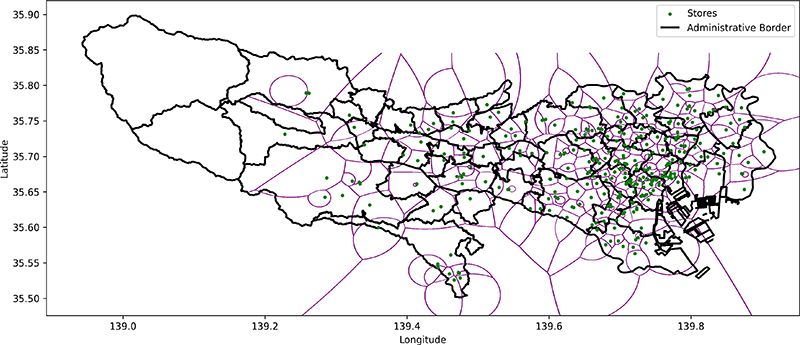
MW-Voronoi diagram for affiliated stores
- [1] G. Voronoi, “Nouvelles applications des paramètres continus à la théorie des formes quadratiques. Premier mémoire. Sur quelques propriétés des formes quadratiques positives parfaites,” J. für die reine und angewandte Mathematik, Vol.1908, No.133, pp. 97-102, 1908. https://doi.org/10.1515/crll.1908.133.97
- [2] F. Aurenhammer, “Voronoi diagrams—A survey of a fundamental geometric data structure,” ACM Computing Surveys, Vol.23, No.3, pp. 345-405, 1991. https://doi.org/10.1145/116873.116880
- [3] A. Okabe, B. Boots, K. Sugihara, and S. N. Chiu, “Spatial Tessellations: Concepts and Applications of Voronoi Diagrams,” John Wiley & Sons, 1992.
- [4] D. L. Huff, “A probabilistic analysis of shopping center trade areas,” Land Economics, Vol.39, No.1, pp. 81-90, 1963. https://doi.org/10.2307/3144521
- [5] D. L. Huff, “Defining and estimating a trading area,” J. of Marketing, Vol.28, No.3, pp. 34-38, 1964. https://doi.org/10.2307/1249154
- [6] Y. Liang, S. Gao, Y. Cai, N. Z. Foutz, and L. Wu, “Calibrating the dynamic Huff model for business analysis using location big data,” Trans. in GIS, Vol.24, No.3, pp. 681-703, 2020. https://doi.org/10.1111/tgis.12624
- [7] R. Suárez-Vega, J. L. Gutiérrez-Acuña, and M. Rodríguez-Díaz, “Locating a supermarket using a locally calibrated Huff model,” Int. J. of Geographical Information Science, Vol.29, No.2, pp. 217-233, 2015. https://doi.org/10.1080/13658816.2014.958154
- [8] T. G. Lin, J. C. Xia, T. P. Robinson, D. Olaru, B. Smith, J. Taplin, and B. Cao, “Enhanced Huff model for estimating Park and Ride (PnR) catchment areas in Perth, WA,” J. of Transport Geography, Vol.54, pp. 336-348, 2016. https://doi.org/10.1016/j.jtrangeo.2016.06.011
- [9] J. A. Jeličić, M. Rapaić, M. Kapetina, S. Medić, and D. Ecet, “Urban planning method for fostering social sustainability: Can bottom-up and top-down meet?,” Results in Engineering, Vol.12, Article No.100284, 2021. https://doi.org/10.1016/j.rineng.2021.100284
- [10] B. Boots and R. South, “Modeling retail trade areas using higher-order, multiplicatively weighted Voronoi diagrams,” J. of Retailing, Vol.73, No.4, pp. 519-536, 1997. https://doi.org/10.1016/S0022-4359(97)90033-6
- [11] H. Tamagawa, “The implications of using a gravity model to determine territory in a circular domain,” Procedia – Social and Behavioral Sciences, Vol.21, pp. 167-176, 2011. https://doi.org/10.1016/j.sbspro.2011.07.009
- [12] T. Drezner, “A review of competitive facility location in the plane,” Logistics Research, Vol.7, Article No.114, 2014. https://doi.org/10.1007/s12159-014-0114-z
- [13] A. H. Thiessen, “Precipitation averages for large areas,” Monthly Weather Review, Vol.39, No.7, pp. 1082-1089, 1911. https://doi.org/10.1175/1520-0493(1911)39%3C1082b:PAFLA%3E2.0.CO;2
- [14] P. Dong, “Generating and updating multiplicatively weighted Voronoi diagrams for point, line and polygon features in GIS,” Computers & Geosciences, Vol.34, No.4, pp. 411-421, 2008. https://doi.org/10.1016/j.cageo.2007.04.005
- [15] H. Alani, C. B. Jones, and D. Tudhope, “Voronoi-based region approximation for geographical information retrieval with gazetteers,” Int. J. of Geographical Information Science, Vol.15, No.4, pp. 287-306, 2001. https://doi.org/10.1080/13658810110038942
- [16] M. Dai, F. Dong, and K. Hirota, “Fuzzy three-dimensional Voronoi diagram and its application to geographical data analysis,” J. Adv. Comput. Intell. Intell. Inform., Vol.16, No.2, pp. 191-198, 2012. https://doi.org/10.20965/jaciii.2012.p0191
- [17] Z. Miao, Y. Chen, X. Zeng, and J. Li, “Integrating spatial and attribute characteristics of extended Voronoi diagrams in spatial patterning research: A case study of Wuhan City in China,” ISPRS Int. J. of Geo-Information, Vol.5, No.7, Article No.120, 2016. https://doi.org/10.3390/ijgi5070120
- [18] Z. Sui, Y. Wen, C. Zhou, X. Huang, Q. Zhang, Z. Liu, and M. A. Piera, “An improved approach for assessing marine traffic complexity based on Voronoi diagram and complex network,” Ocean Engineering, Vol.266, Article No.112884, 2022. https://doi.org/10.1016/j.oceaneng.2022.112884
- [19] R. Hettiarachchi and J. F. Peters, “Multi-manifold-based skin classifier on feature space Voronoï regions for skin segmentation,” J. of Visual Communication and Image Representation, Vol.41, pp. 123-139, 2016. https://doi.org/10.1016/j.jvcir.2016.09.011
- [20] R. Hettiarachchi and J. F. Peters, “Voronoï region-based adaptive unsupervised color image segmentation,” Pattern Recognition, Vol.65, pp. 119-135, 2017. https://doi.org/10.1016/j.patcog.2016.12.011
- [21] S. Takumi and S. Miyamoto, “Nearest prototype and nearest neighbor clustering with twofold memberships based on inductive property,” J. Adv. Comput. Intell. Intell. Inform., Vol.17, No.4, pp. 504-510, 2013. https://doi.org/10.20965/jaciii.2013.p0504
- [22] S. Ide, S. Sumitsuji, O. Yamaguchi, and Y. Sakata, “Cardiac computed tomography-derived myocardial mass at risk using the Voronoi-based segmentation algorithm: A histological validation study,” J. of Cardiovascular Computed Tomography, Vol.11, No.3, pp. 179-182, 2017. https://doi.org/10.1016/j.jcct.2017.04.007
- [23] L. C. Galvão, A. G. N. Novaes, J. E. Souza de Cursi, and J. C. Souza, “A multiplicatively-weighted Voronoi diagram approach to logistics districting,” Computers & Operations Research, Vol.33, No.1, pp. 93-114, 2006. https://doi.org/10.1016/j.cor.2004.07.001
- [24] M. Wang, R. Ou, and Y. Wang, “Multiplicatively weighted Voronoi-based sensor collaborative redeployment in software-defined wireless sensor networks,” Int. J. of Distributed Sensor Networks, Vol.18, No.3, Article No.15501477211069903, 2022. https://doi.org/10.1177/15501477211069903
- [25] J. Kim, C. Ju, and H. I. Son, “A Multiplicatively Weighted Voronoi-Based Workspace Partition for Heterogeneous Seeding Robots,” Electronics, Vol.9, No.11, Article No.1813, 2020. https://doi.org/10.3390/electronics9111813
- [26] M. De Beule, D. Van den Poel, and N. Van de Weghe, “An extended Huff-model for robustly benchmarking and predicting retail network performance,” Applied Geography, Vol.46, pp. 80-89, 2014. https://doi.org/10.1016/j.apgeog.2013.09.026
- [27] I. Marić, A. Siljeg, F. Domazetovic, L. Pandja, R. Milosevic, S. Siljeg, and R. Marinovic, “How to delineate urban gravitational zones? GIS-based multicriteria decision analysis and Huff’s model in urban hierarchy modeling,” Papers in Regional Science, Vol.103, No.2, Article No.100015, 2024. https://doi.org/10.1016/j.pirs.2024.100015
- [28] S. Wang, N. N. Kong, and Y. Gao, “Use mobile location data to infer airport catchment areas and calibrate Huff gravity model in the New York metropolitan area,” J. of Transport Geography, Vol.114, Article No.103790, 2024. https://doi.org/10.1016/j.jtrangeo.2023.103790
- [29] L. Bello, R. Blanquero, and E. Carrizosa, “On minimax-regret Huff location models,” Computers & Operations Research, Vol.38, No.1, pp. 90-97, 2011. https://doi.org/10.1016/j.cor.2010.04.001
- [30] R. Blanquero, E. Carrizosa, B. G.-Tóth, and A. Nogales-Gómez, “p-facility Huff location problem on networks,” European J. of Operational Research, Vol.255, No.1, pp. 34-42, 2016. https://doi.org/10.1016/j.ejor.2016.04.039
- [31] S. Grohmann, D. Urošević, E. Carrizosa, and N. Mladenović, “Solving multifacility Huff location models on networks using metaheuristic and exact approaches,” Computers & Operations Research, Vol.78, pp. 537-546, 2017. https://doi.org/10.1016/j.cor.2016.03.005
- [32] B. G.-Tóth, L. Anton-Sanchez, and J. Fernández, “A Huff-like location model with quality adjustment and/or closing of existing facilities,” European J. of Operational Research, Vol.313, No.3, pp. 937-953, 2024. https://doi.org/10.1016/j.ejor.2023.08.054
- [33] T. Kawamoto and T. Hasuike, “A practical order assignment method to affiliated stores using Huff’s model,” IEEJ Trans. on Electronics, Information and Systems, Vol.144, No.8, pp. 742-748, 2024 (in Japanese). https://doi.org/10.1541/ieejeiss.144.742
- [34] T. Kawamoto and T. Hasuike, “Application of Analytic Hierarchy Process for order assignment to affiliated stores,” Proc. of the 2024 16th IIAI Int. Congress on Advanced Applied Informatics (IIAI-AAI), pp. 572-577, 2024. https://doi.org/10.1109/IIAI-AAI63651.2024.00109
- [35] T. Kawamoto and T. Hasuike, “Dynamic order assignment methods to affiliated stores using Voronoi tessellation,” Communications of the Operations Research Society of Japan, Vol.67, No.11, pp. 619-630, 2022 (in Japanese).
This article is published under a Creative Commons Attribution-NoDerivatives 4.0 Internationa License.