
Research Paper:
English Vocabulary Memory Intelligent Review System Supported by Deep Learning
Liting Wang†
School of Foreign Languages, Anshan Normal University
No.43 Ping’an Street, Tiandong District, Anshan, Liaoning 114056, China
†Corresponding author

In the context of globalization, English learning is becoming increasingly important, but traditional vocabulary memorization methods have many limitations. This paper constructs an intelligent review system for English vocabulary memorization based on deep learning, integrating big data analysis and personalized learning theory. Through word vector generation and reinforcement learning algorithms, the system realizes vocabulary representation learning, memory updating, and personalized review strategy generation. The experiment selected 50 English learners and divided them into an experimental group and a control group for comparison. The results showed that the experimental group had an average score of 75.36 in the later immediate recall test and an average score of 62.48 in the delayed memory test, which were significantly higher than those of the control group, and the learning time was reduced by 19.05% and the learning pressure was reduced by 21.43%. The system effectively improves the efficiency and persistence of vocabulary memory, provides an efficient and personalized tool for English learning, and promotes the development of language learning theory.
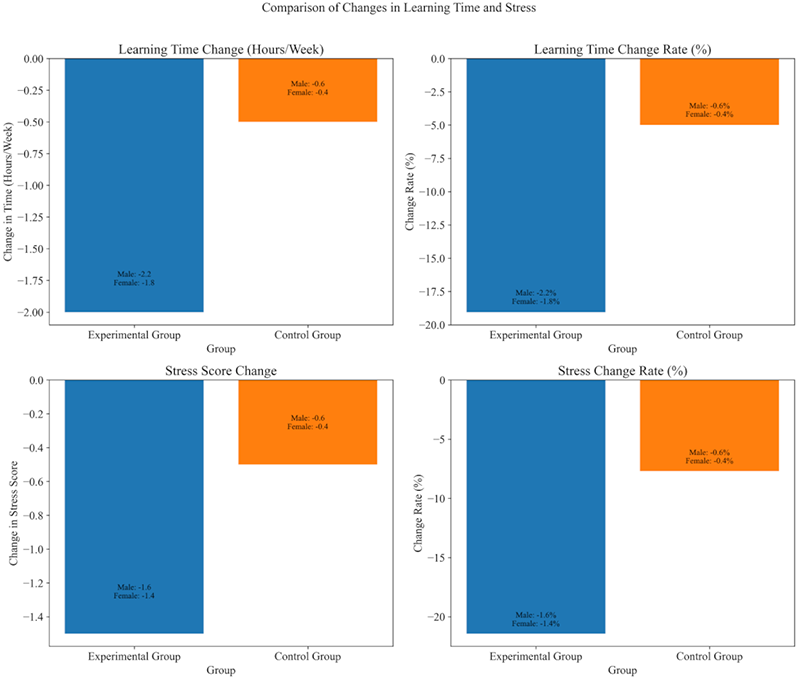
Comparison of learning time and stress before and after learners use the system
- [1] L. Duan, “Test of English vocabulary recognition based on natural language processing and corpus system,” J. of Intelligent & Fuzzy Systems, Vol.40, No.4, pp. 7073-7084, 2021. https://doi.org/10.3233/JIFS-189537
- [2] A. Mickan, E. Slesareva, J. M. McQueen, and K. Lemhöfer, “New in, old out: Does learning a new language make you forget previously learned foreign languages?,” Quarterly J. of Experimental Psychology, Vol.77, No.3, pp. 530-550, 2024. https://doi.org/10.1177/17470218231181380
- [3] Y. S. G. Kim, N. Gutierrez, and Y. Petscher, “Decomposing variation in vocabulary and listening comprehension task performance in Spanish and English into person, ecological, and assessment differences for Spanish–English bilingual children in the United States,” J. of Speech, Language, and Hearing Research, Vol.67, No.10, pp. 3733-3747, 2024. https://doi.org/10.1044/2024_jslhr-23-00702
- [4] S. I. Gray, R. Levy, M. Alt, T. P. Hogan, and N. Cowan, “Working memory predicts new word learning over and above existing vocabulary and nonverbal IQ,” J. of Speech, Language, and Hearing Research, Vol.65, No.3, pp. 1044-1069, 2022. https://doi.org/10.1044/2021_jslhr-21-00397
- [5] Y. Wang, “Construction and improvement of English vocabulary learning model integrating spiking neural network and convolutional long short-term memory algorithm,” PLOS ONE, Vol.19, No.3, Article No.e0299425, 2024. https://doi.org/10.1371/journal.pone.0299425
- [6] S. K. Carpenter and J. Geller, “Is a picture really worth a thousand words? Evaluating contributions of fluency and analytic processing in metacognitive judgements for pictures in foreign language vocabulary learning,” Quarterly J. of Experimental Psychology, Vol.73, No.2, pp. 211-224, 2020. https://doi.org/10.1177/1747021819879416
- [7] J. Stolvoort, M. Mackaaij, and E. Tribushinina, “Age of onset, motivation, and anxiety as predictors of grammar and vocabulary outcomes in English as a foreign language learners with developmental language disorder,” J. of Communication Disorders, Vol.108, Article No.106407, 2024. https://doi.org/10.1016/j.jcomdis.2024.106407
- [8] M. Chawla, S. N. Panda, V. Khullar, K. D. Garg, and M. Angurala, “Deep learning based next word prediction aided assistive gaming technology for people with limited vocabulary,” Entertainment Computing, Vol.50, Article No.100661, 2024. https://doi.org/10.1016/j.entcom.2024.100661
- [9] N. Tsuboi and W. S. Francis, “Rethinking bilingual enhancement effects in associative learning of foreign language vocabulary: The role of proficiency in the mediating language,” J. of Memory and Language, Vol.115, Article No.104155, 2020. https://doi.org/10.1016/j.jml.2020.104155
- [10] E. Pontecorvo et al., “Learning a sign language does not hinder acquisition of a spoken language,” J. of Speech, Language, and Hearing Research, Vol.66, No.4, pp. 1291-1308, 2023. https://doi.org/10.1044/2022_jslhr-22-00505
- [11] J. Wu and B. Chen, “English vocabulary online teaching based on machine learning recognition and target visual detection,” J. of Intelligent & Fuzzy Systems: Applications in Engineering and Technology, Vol.39, No.2, pp. 1745-1756, 2020. https://doi.org/10.3233/jifs-179948
- [12] M. Habbash et al., “Recognition of Arabic accents from English spoken speech using deep learning approach,” IEEE Access, Vol.12, pp. 37219-37230, 2024. https://doi.org/10.1109/access.2024.3374768
- [13] D. C. Friesen, K. Edwards, and C. Lamoureux, “Predictors of verbal fluency performance in monolingual and bilingual children: The interactive role of English receptive vocabulary and fluid intelligence,” J. of Communication Disorders, Vol.89, Article No.106074, 2021. https://doi.org/10.1016/j.jcomdis.2020.106074
- [14] N. Tibbits, H. S. Lancaster, and B. de Diego-Lázaro, “The effect of phonological overlap on English and Spanish expressive vocabulary,” Language, Speech, and Hearing Services in Schools, Vol.54, No.1, pp. 212-223, 2023. https://doi.org/10.1044/2022_lshss-22-00021
- [15] C. Frances, A. de Bruin, and J. A. Duñabeitia, “The effects of language and emotionality of stimuli on vocabulary learning,” PLOS ONE, Vol.15, No.10, Article No.e0240252, 2020. https://doi.org/10.1371/journal.pone.0240252
- [16] T. Zhao and M. B. Alias, “Automated programming approaches to enhance computer-aided translation accuracy,” PeerJ Computer Science, Vol.10, Article No.e2396, 2024. https://doi.org/10.7717/peerj-cs.2396
- [17] C. Li, L. Fan, and B. Wang, “Post-encoding positive emotion impairs associative memory for English vocabulary,” PLOS ONE, Vol.15, No.4, Article No.e0228614, 2020. https://doi.org/10.1371/journal.pone.0228614
- [18] K. Qu, T. Liu, Y. Qiao, and P. Wang, “The facilitative effect of the keyword mnemonic on L2 vocabulary retrieval practice,” Heliyon, Vol.10, No.3, Article No.e25212, 2024. https://doi.org/10.1016/j.heliyon.2024.e25212
- [19] C.-Y. Lin and J.-T. Chu, “ Adopting AI tools and mobile technology to assist college students in English learning,” Int. J. of Organizational Innovation, Vol.18. No.2, pp. 105-129, 2025.
- [20] M. H. Oh and J. Mancilla-Martinez, “Comparing vocabulary knowledge conceptualizations among Spanish–English dual language learners in a new destination state,” Language, Speech, and Hearing Services in Schools, Vol.52, No.1, pp. 369-382, 2021. https://doi.org/10.1044/2020_lshss-20-00031
- [21] C.-H. Yin and F.-P. G. Yang, “The effects of working memory capacity in metaphor and metonymy comprehension in Mandarin–English bilinguals’ minds: An fMRI study,” Brain Sciences, Vol.12, No.5, Article No.633, 2022. https://doi.org/10.3390/brainsci12050633
- [22] H. Guo and Z. Li, “An analysis of the learning effects and differences of college students using English vocabulary APP,” Sustainability, Vol.14, No.15, Article No.9240, 2022. https://doi.org/10.3390/su14159240
- [23] P. F. Kan, S. Huang, E. Winicour, and J. Yang, “Vocabulary growth: Dual language learners at risk for language impairment,” American J. of Speech-Language Pathology, Vol.29, No.3, pp. 1178-1195, 2020. https://doi.org/10.1044/2020_ajslp-19-00160
- [24] M. Weerasinghe et al., “VocabulARy: Learning vocabulary in AR supported by keyword visualisations,” IEEE Trans. on Visualization and Computer Graphics, Vol.28, No.11, pp. 3748-3758, 2022. https://doi.org/10.1109/tvcg.2022.3203116
This article is published under a Creative Commons Attribution-NoDerivatives 4.0 Internationa License.