
Research Paper:
Intelligent Evaluation Algorithm for English Teaching Quality Based on HMIPSO-Optimized BP Neural Networks
Feng Liu†
Maritime College, Hainan Vocational University of Science and Technology
No.18 Qiongshan Avenue, Meilan District, Haikou City, Hainan 571126, China
†Corresponding author

Traditional methods for assessing English teaching quality in higher education have gradually revealed their limitations, failing to reflect the dynamic changes comprehensively and accurately in the teaching process and the multidimensional nature of teaching outcomes. This study proposes an English teaching quality evaluation model based on the combination of a hybrid multi-strategy improved particle swarm optimization (HMIPSO) and backpropagation (BP) neural network. A teaching quality evaluation system is constructed using teaching content, teaching methods, and teaching outcomes. Experimental results show that the HMIPSO-BP model outperforms the traditional BP neural network model, with the mean squared error reduced by approximately 27.8% and the minimum error decreased by approximately 28.2%. This approach significantly reduces computation time while maintaining evaluation accuracy. The proposed method provides a novel and effective technical pathway for monitoring and improving the quality of English teaching in higher education.
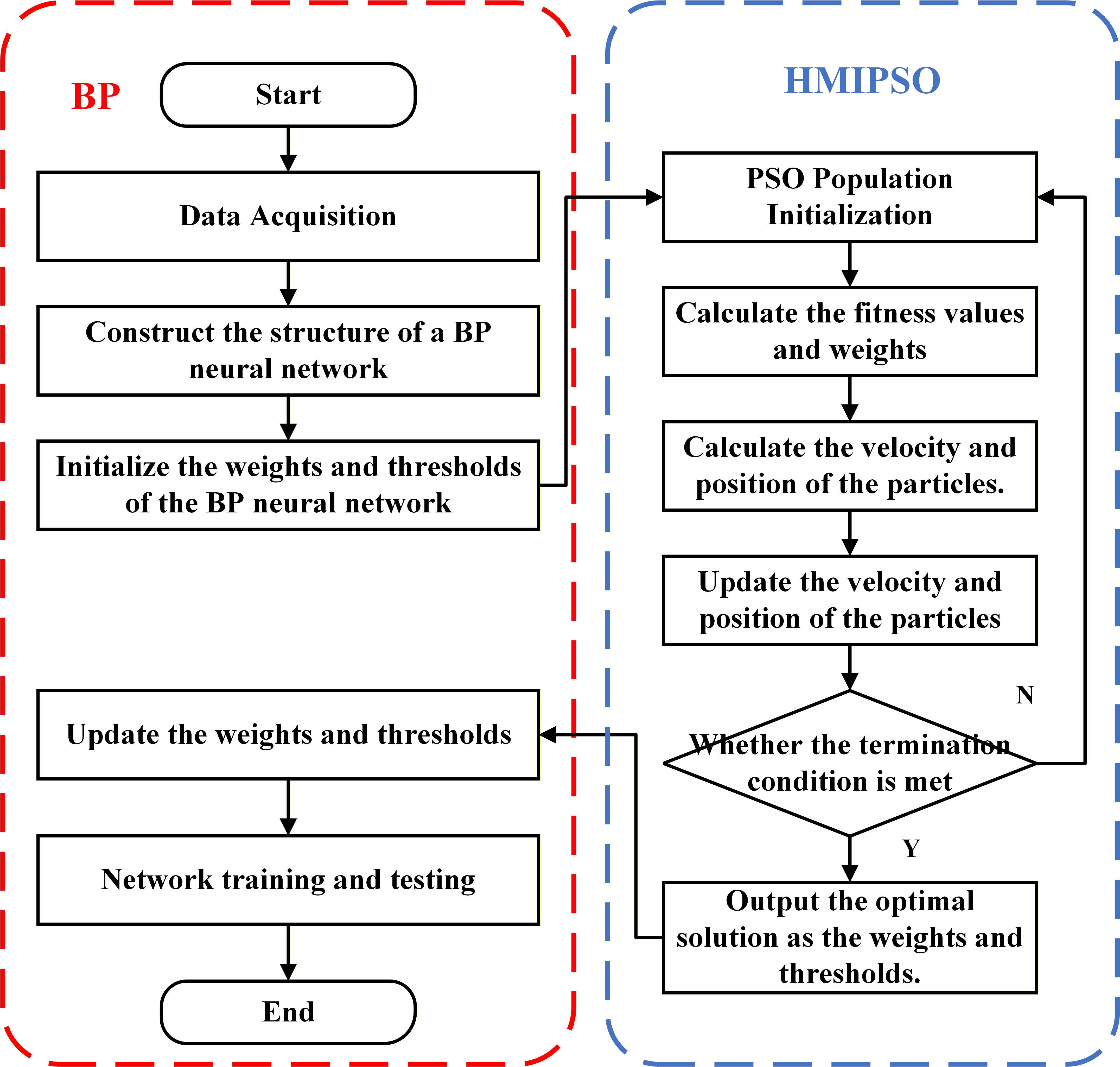
Flowchart of HMIPSO-BP algorithm
- [1] M. Ďurišová, A. Kucharčíková, and E. Tokarčíková, “Assessment of higher education teaching outcomes (quality of higher education),” Procedia – Social and Behavioral Sciences, Vol.174, pp. 2497-2502, 2015. https://doi.org/10.1016/j.sbspro.2015.01.922
- [2] Y. Zhou, S. Zou, M. Liwang, Y. Sun, and W. Ni, “A teaching quality evaluation framework for blended classroom modes with multi-domain heterogeneous data integration,” Expert Systems with Applications, Vol.289, Article No.127884, 2025. https://doi.org/10.1016/j.eswa.2025.127884
- [3] M. Qian and L. Zhao, “Empowering undergraduate teaching quality evaluation with big data: Value connotations, realistic dilemmas and path choices,” Chongqing Higher Education Research, Vol.11, pp. 40-48, 2023. https://doi.org/10.15998/j.cnki.issn1673-8012.2023.05.004
- [4] R. Liu, Y. Zhang, and X. Fang, “Research on the influencing factors of business teachers’ teaching quality: PLS-SEM and ANN approach,” The Int. J. of Management Education, Vol.23, No.2, Article No.101134, 2025. https://doi.org/10.1016/j.ijme.2025.101134
- [5] Y. Zhao, W. Li, H. Jiang, M. Siyiti, M. Zhao, S. You, Y. Li, and P. Yan, “Development of a blended teaching quality evaluation scale (BTQES) for undergraduate nursing based on the Context, Input, Process and Product (CIPP) evaluation model: A cross-sectional survey,” Nurse Education in Practice, Vol.77, Article No.103976, 2024. https://doi.org/10.1016/j.nepr.2024.103976
- [6] F. Xia, “Optimized multiple-attribute group decision-making through employing probabilistic hesitant fuzzy TODIM and EDAS technique and application to teaching quality evaluation of international Chinese course in higher vocational colleges,” Heliyon, Vol.10, Article No.e25758, 2024. https://doi.org/10.1016/j.heliyon.2024.e25758
- [7] R. Chen, X. Luo, Q. Nie, L. Wang, J. Li, and X. Zeng, “BP-CM model: A teaching model for improving the teaching quality of IoT hardware technology based on BOPPPS and memory system,” Education and Information Technologies, Vol.28, pp. 6249-6268, 2023. https://doi.org/10.1007/s10639-022-11432-7
- [8] J. Chang, J. Huang, and Y. Hu, “Optimizing information dissemination model for improvement of college students’ education based on learning community,” Mobile Information Systems, Vol.2021, Article No.3815943, 2021. https://doi.org/10.1155/2021/3815943
- [9] H. Zhang, B. Xiao, J. Li, and M. Hou, “An improved genetic algorithm and neural network-based evaluation model of classroom teaching quality in colleges and universities,” Wireless Communications and Mobile Computing, Vol.2021, Article No.2602385, 2021. https://doi.org/10.1155/2021/2602385
- [10] S. Li, T. Shi, and J. Kuang, “Exploration and practice of informatization means in the quality supervision of college classroom teaching,” J. Phys.: Conf. Ser., Vol.1345, No.4, Article No.042032, 2019. https://doi.org/10.1088/1742-6596/1345/4/042032
- [11] Y. Sun and M. Jiang, “An evaluation model for the teaching reform of the physical education industry,” Discrete Dynamics in Nature and Society, Vol.2021, Article No.7147554, 2021. https://doi.org/10.1155/2021/7147554
- [12] Y. Li and H. Zhang, “Big data technology for teaching quality monitoring and improvement in higher education – Joint K-means clustering algorithm and Apriori algorithm,” Systems and Soft Computing, Vol.6, Article No.200125, 2024. https://doi.org/10.1016/j.sasc.2024.200125
- [13] T. Zhang, J. Liu, and H. Hu, “Teaching quality evaluation based on IPSO-BP neural network model,” Research and Exploration in Laboratory, Vol.42, pp. 174-178, 2023. https://doi.org/10.19927/j.cnki.syyt.2023.06.035
- [14] P. Wang, “Application and analysis of fuzzy hierarchical model in teaching quality assessment of primary education,” Proc. 3rd Int. Conf. Smart Generation Computing, Communication and Networking (SMART GENCON), 2023. https://doi.org/10.1109/SMARTGENCON60755.2023.10442273
- [15] Y. Zhang, “Application and analysis of fuzzy hierarchical model in education and teaching quality assessment,” Proc. IEEE Int. Conf. Information Technology, Electronics and Intelligent Communication Systems (ICITEICS), 2024. https://doi.org/10.1109/ICITEICS61368.2024.10625010
- [16] X. Guo, M. Gao, M. Zhang, Y. Chen, and S.-P. Tseng, “Design and implementation of teaching quality assessment system based on analytic hierarchy process fuzzy comprehensive evaluation method,” Proc. 8th Int. Conf. Orange Technol. (ICOT), 2020. https://doi.org/10.1109/ICOT51877.2020.9468778
- [17] M. Yuan, “Evaluation method of English teaching quality based on improved kernel extreme learning machine of analytical hierarchy process and krill herd,” Proc. IEEE 11th Joint Int. Inf. Technol. and Artificial Intelligence Conf. (ITAIC), pp. 1854-1859, 2023. https://doi.org/10.1109/ITAIC58329.2023.10408892
- [18] X. Ying and G. Vallejos, “Quality assessment model of middle school geography teaching practice course based on decision tree algorithm,” Proc. 5th Int. Conf. Applied Machine Learning (ICAML), pp. 65-70, 2023. https://doi.org/10.1109/ICAML60083.2023.00022
- [19] F. Li, “Research on intelligent assessment algorithm of English teaching diagnosis system based on SVM,” Proc. Int. Conf. Electronics and Devices, Computational Science (ICEDCS), pp. 618-621, 2023. https://doi.org/10.1109/ICEDCS60513.2023.00118
- [20] D. Zhang, “Quality evaluation of college English classroom teaching based on K-means clustering algorithm,” Proc. Int. Conf. Intelligent Systems and Computational Networks (ICISCN), 2025. https://doi.org/10.1109/ICISCN64258.2025.10934355
- [21] S. Yuan, “A K-means algorithm for higher education quality assessment system,” Proc. Int. Conf. Intelligent Computing, Communication and Convergence (ICI3C), pp. 289-293, 2023. https://doi.org/10.1109/ICI3C60830.2023.00062
- [22] Y. Li, “The quality evaluation of English talent training in universities based on K-means algorithm,” Proc. IEEE Int. Conf. Integrated Circuits and Communication Systems (ICICACS), 2023. https://doi.org/10.1109/ICICACS57338.2023.10100228
- [23] A. Li, “Research on the effectiveness of data mining algorithms in music educational assessment,” Proc. Int. Conf. Interactive Intelligent Systems and Techniques (IIST), pp. 355-360, 2024. https://doi.org/10.1109/IIST62526.2024.00136
- [24] Y. Liu, J. Xue, D. Li, W. Zhang, T. K. Chiew, and Z. Xu, “Image recognition based on lightweight convolutional neural network: Recent advances,” Image and Vision Computing, Vol.146, Article No.105037, 2024. https://doi.org/10.1016/j.imavis.2024.105037
- [25] Z. Salahuddin, H. C. Woodruff, A. Chatterjee, and P. Lambin, “Transparency of deep neural networks for medical image analysis: A review of interpretability methods,” Computers in Biology and Medicine, Vol.140, Article No.105111, 2022. https://doi.org/10.1016/j.compbiomed.2021.105111
- [26] Z. Nan, “Research on the application of BP algorithm of neural network in teaching quality evaluation,” Proc. Int. Conf. Optimization Computing and Wireless Communication (ICOCWC), 2024. https://doi.org/10.1109/ICOCWC60930.2024.10470499
- [27] P. Ge, T. Fan, G. Wang, Z. Zang, and X. Tao, “CA-BPNN-based multi-modal fusion teaching quality evaluation method,” Proc. IEEE Int. Conf. Progress in Informatics and Computing (PIC), pp. 29-35, 2024. https://doi.org/10.1109/PIC62406.2024.10892784
- [28] Y. Yao, X. Gao, and Q. Shen, “Research on the evaluation of mathematical teaching quality based on K-means and BP algorithm,” Proc. 7th Int. Conf. Education, Network and Information Technology (ICENIT), pp. 203-208, 2024. https://doi.org/10.1109/ICENIT61951.2024.00044
- [29] Y. Gao, Y. Zhang, and L. Li, “Undergraduate practice teaching job quality assessment based on artificial fish-BP neural network,” Proc. ISECS Int. Colloquium on Computing, Communication, Control, and Management, pp. 379-382, 2009. https://doi.org/10.1109/CCCM.2009.5267921
- [30] H. Zhang, M. Zhang, X. Qu, W. Peng, H. Zhang, and Y. Zhang, “Evaluation and prediction of water quality in the Beijing section of Yongding River based on CEWI index and BP neural network,” Environmental Science, Vol.XX, pp. 1-17, 2025 (in Chinese). https://doi.org/10.13227/j.hjkx.202503067
- [31] X. Wu, M. Guo, A. Hu, and Q. Wu, “Path planning for UAV based on improved genetic particle swarm optimization,” Chinese J. of Scientific Instruments, Vol.XX, pp. 1-11, 2025 (in Chinese). https://doi.org/10.19650/j.cnki.cjsi.J2413512
- [32] B. Lei, H. Tang, Y. Su, Y. Ru, and S. Fei, “Fuzzy adaptive power optimization control of wind turbine with improved whale optimization algorithm and kernel extreme learning machine,” Expert Systems with Applications, Vol.272, Article No.126750, 2025. https://doi.org/10.1016/j.eswa.2025.126750
- [33] Z. Han, Y. Sun, and J. Huang, “Construction of teaching quality evaluation model for college physical education based on PSO-BPNN algorithm,” J. Chongqing Univ. Educ., Vol.37, pp. 107-112, 2024.
This article is published under a Creative Commons Attribution-NoDerivatives 4.0 Internationa License.