
Research Paper:
Dual-Objective Optimization Model for Low Carbon Cold-Chain Logistics
Chaofan Wang*,†
 and Takashi Hasuike**
*Graduate School of Science and Engineering, Waseda University
3-4-1 Okubo, Shinjuku-ku, Tokyo 169-8555, Japan
†Corresponding author
**Faculty of Science and Engineering, Waseda University
3-4-1 Okubo, Shinjuku-ku, Tokyo 169-8555, Japan

Cold-chain logistics plays a crucial role in maintaining the quality of temperature-sensitive products. However, it generates high energy consumption and carbon emissions due to refrigeration and complex routing operations. Therefore, this study proposes a dual-objective optimization model for low carbon cold-chain vehicle routing that simultaneously minimizes total logistics and carbon emission costs. The model comprehensively integrates transportation, refrigeration, cargo damage, and holding costs, as well as emissions from fuel consumption and refrigeration energy use. To solve the proposed model, two multi-objective evolutionary algorithms, the non-dominated sorting genetic algorithm II (NSGA-II) and the multi-objective particle swarm optimization (MOPSO), were employed and compared under the same experimental framework. Numerical experiments based on Solomon benchmark instances demonstrate that both algorithms can effectively generate Pareto-optimal solutions. NSGA-II shows superior convergence and better diversity maintenance, whereas MOPSO achieves faster early-stage convergence and stronger global exploration. The comparative analysis, supported by quantitative performance metrics and visual results, confirms the reliability of the proposed optimization model and highlights the complementary characteristics of the two algorithms. The findings provide theoretical and practical insights for designing sustainable, cost-efficient, and environmentally friendly cold-chain logistics systems.
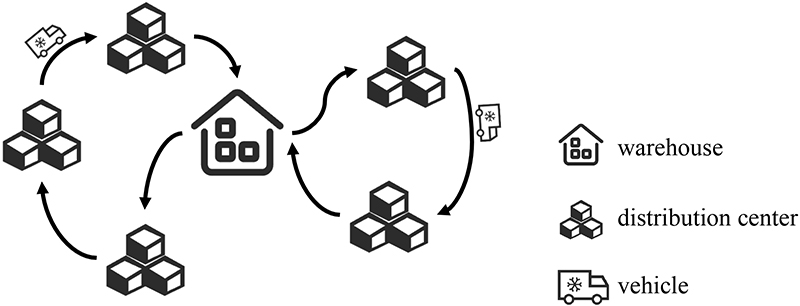
Schematic diagram of cold-chain logistics distribution network
- [1] M. F. M. S. Mustafa, N. Navaranjan, and A. Demirovic, “Food cold chain logistics and management: A review of current development and emerging trends,” J. of Agriculture and Food Research, Vol.18, Article No.101343, 2024. https://doi.org/10.1016/j.jafr.2024.101343
- [2] B. M. Baker and M. A. Ayechew, “A genetic algorithm for the vehicle routing problem,” Computers & Operations Research, Vol.30, No.5, pp. 787-800, 2003. https://doi.org/10.1016/S0305-0548(02)00051-5
- [3] S.-X. Wang and C.-Y. Wei, “Demand prediction of cold chain logistics under B2C E-commerce model,” J. Adv. Comput. Intell. Intell. Inform., Vol.22, No.7, pp. 1082-1087, 2018. https://doi.org/10.20965/jaciii.2018.p1082
- [4] S. Verma, M. Pant, and V. Snasel, “A comprehensive review on NSGA-II for multi-objective combinatorial optimization problems,” IEEE Access, Vol.9, pp. 57757-57791, 2021. https://doi.org/10.1109/ACCESS.2021.3070634
- [5] T. M. Shami, A. A. El-Saleh, M. Alswaitti, Q. Al-Tashi, M. A. Summakieh, and S. Mirjalili, “Particle swarm optimization: A comprehensive survey,” IEEE Access, Vol.10, pp. 10031-10061, 2022. https://doi.org/10.1109/ACCESS.2022.3142859
- [6] P. Ghosh, A. Jha, and R. Sharma, “Managing carbon footprint for a sustainable supply chain: A systematic literature review,” Modern Supply Chain Research and Applications, Vol.2, No.3, pp. 123-141, 2020. https://doi.org/10.1108/MSCRA-06-2020-0016
- [7] J. Tang, K. Liu, and Q. Chen, “Study on cold chain logistics of vehicle routing problem for agricultural products,” Proc. of 2013 IEEE Int. Conf. on Service Operations and Logistics, and Informatics, pp. 317-322, 2013. https://doi.org/10.1109/SOLI.2013.6611433
- [8] C.-X. Huai, G.-H. Sun, R.-R. Qu, Z. Gao, and Z.-H. Zhang, “Vehicle routing problem with multi-type vehicles in the cold chain logistics system,” 2019 16th Int. Conf. on Service Systems and Service Management (ICSSSM), 2019. https://doi.org/10.1109/ICSSSM.2019.8887612
- [9] H. Deng, M. Wang, Y. Hu, J. Ouyang, and B. Li, “An improved distribution cost model considering various temperatures and random demands: A case study of Harbin cold-chain logistics,” IEEE Access, Vol.9, pp. 105521-105531, 2021. https://doi.org/10.1109/ACCESS.2021.3100577
- [10] F. Li et al., “Simulation and optimization of cold chain logistics system towards lower carbon emission: a state-of-the-art review,” Carbon Res., Vol.4, No.1, Article No.22, 2025. https://doi.org/10.1007/s44246-024-00191-4
- [11] G. Liu, J. Hu, Y. Yang, S. Xia, and M. K. Lim, “Vehicle routing problem in cold Chain logistics: A joint distribution model with carbon trading mechanisms,” Resources, Conservation and Recycling, Vol.156, Article No.104715, 2020. https://doi.org/10.1016/j.resconrec.2020.104715
- [12] N. Tao, H. Yumeng, and F. Meng, “Research on cold chain logistics optimization model considering low-carbon emissions,” Int. J. of Low-Carbon Technologies, Vol.18, pp. 354-366, 2023. https://doi.org/10.1093/ijlct/ctad021
- [13] M. Y. Appiah and S. Huaping, “Solving a low-carbon routing problem for perishable distribution food,” Int. J. of Sustainable Engineering, Vol.17, No.1, pp. 867-882, 2024. https://doi.org/10.1080/19397038.2024.2409157
- [14] K. Ransikarbum, N. Wattanasaeng, and S. C. Madathil, “Analysis of multi-objective vehicle routing problem with flexible time windows: The implication for open innovation dynamics,” J. of Open Innovation: Technology, Market, and Complexity, Vol.9, No.1, Article No.100024, 2023. https://doi.org/10.1016/j.joitmc.2023.100024
- [15] Z. Yuan, H. Ouyang, S. Li, E. H. Houssein, and N. A. Samee, “Multi-objective differential evolution algorithm integrating a directional generation mechanism for multi-objective optimization problems,” Applied Soft Computing, Vol.184, Part B, Article No.113791, 2025. https://doi.org/10.1016/j.asoc.2025.113791
- [16] Q. Bai, X. Yin, M. K. Lim, and C. Dong, “Low-carbon VRP for cold chain logistics considering real-time traffic conditions in the road network,” Industrial Management Data Systems, Vol.122, No.2, pp. 521-543, 2022. https://doi.org/10.1108/IMDS-06-2020-0345
- [17] Y. Li, M. K. Lim, and M.-L. Tseng, “A green vehicle routing model based on modified particle swarm optimization for cold chain logistics,” Industrial Management & Data Systems, Vol.119, No.3, pp. 473-494, 2019. https://doi.org/10.1108/IMDS-07-2018-0314
- [18] J. Chen, P. Gui, T. Ding, S. Na, and Y. Zhou, “Optimization of transportation routing problem for fresh food by improved ant colony algorithm based on tabu search,” Sustainability, Vol.11, No.23, Article No.6584, 2019. https://doi.org/10.3390/su11236584
- [19] S. Wang, F. Tao, and Y. Shi, “Optimization of location–routing problem for cold chain logistics considering carbon footprint,” Int. J. of Environmental Research and Public Health, Vol.15, No.1, Article No.86, 2018. https://doi.org/10.3390/ijerph15010086
- [20] Y. Li, M. K. Lim, W. Xiong, X. Huang, Y. Shi, and S. Wang, “An electric vehicle routing model with charging stations consideration for sustainable logistics,” Industrial Management & Data Systems, Vol.124, No.3, pp. 1076-1106, 2024. https://doi.org/10.1108/IMDS-08-2023-0581
- [21] S. Ubeda, F. J. Arcelus, and J. Faulin, “Green logistics at Eroski: A case study,” Int. J. of Production Economics, Vol.131, No.1, pp. 44-51, 2011. https://doi.org/10.1016/j.ijpe.2010.04.041
- [22] P. Gajendran and N. N. Clark, “Effect of truck operating weight on heavy-duty diesel emissions,” Environ. Sci. Technol., Vol.37, No.18, pp. 4309-4317, 2003. https://doi.org/10.1021/es026299y
- [23] A. Bozorgi, J. Pazour, and D. Nazzal, “A new inventory model for cold items that considers costs and emissions,” Int. J. of Production Economics, Vol.155, pp. 114-125, 2014. https://doi.org/10.1016/j.ijpe.2014.01.006
- [24] K. Deb, S. Agrawal, A. Pratap, and T. Meyarivan, “A fast elitist non-dominated sorting genetic algorithm for multi-objective optimization: NSGA-II,” M. Schoenauer, K. Deb, G. Rudolph, X. Yao, E. Lutton, J. J. Merelo, and H.-P. Schwefel (Eds.), “Parallel Problem Solving from Nature PPSN VI,” Lecture Notes in Computer Science, Vol.1917, pp. 849-858, 2000. https://doi.org/10.1007/3-540-45356-3_83
- [25] K. Li, D. Li, and D. Wu, “Carbon transaction-based location-routing- inventory optimization for cold chain logistics,” Alexandria Engineering J., Vol.61, No.10, pp. 7979-7986, 2022. https://doi.org/10.1016/j.aej.2022.01.062
- [26] A. K. Garside, R. Ahmad, and M. N. B. Muhtazaruddin, “A recent review of solution approaches for green vehicle routing problem and its variants,” Operations Research Perspectives, Vol.12, Article No.100303, 2024. https://doi.org/10.1016/j.orp.2024.100303
- [27] Y. Wang, J. Zhe, X. Wang, Y. Sun, and H. Wang, “Collaborative multidepot vehicle routing problem with dynamic customer demands and time windows,” Sustainability, Vol.14, No.11, Article No.6709, 2022. https://doi.org/10.3390/su14116709
- [28] M. M. Solomon, “Algorithms for the vehicle routing and scheduling problems with time window constraints,” Operations Research, Vol.35, No.2, pp. 254-265, 1987. https://doi.org/10.1287/opre.35.2.254
This article is published under a Creative Commons Attribution-NoDerivatives 4.0 Internationa License.