
Research Paper:
Exploring the Relationship Between University Students’ Satisfaction with Physical Education Courses and Their Well-Being
Jen-Yi Huang*1,*2, Kuang-Nan Tsai*3, and Tsung-Kuo Tien-Liu*4,†

*1Department of Physical Education and Sport Sciences, National Taiwan Normal University
No.885-3 Sec. 2, Zhongshan Rd., Changhua, Changhua 500002, Taiwan
*2Department Education of Sports, National Changhua University
No.1 Jinde Rd., Changhua, Changhua 500207, Taiwan
*3Department of Beauty Science, Meiho University
23 Pingguang Rd., Neipu, Pingtung 912, Taiwan
*4Department of Sport and Leisure Management, Meiho University
23 Pingguang Rd., Neipu, Pingtung 912, Taiwan
†Corresponding author

This study examines the relationship between university students’ multidimensional satisfaction with physical education (PE) courses and their subjective well-being, grounded in positive psychology. After data screening, the final valid sample comprised 422 students. Two validated instruments were employed: the Chinese version of the physical activity-class satisfaction questionnaire and a well-being questionnaire adapted from the literature. Using descriptive statistics, reliability analysis, and structural equation modeling, the study confirmed that PE course satisfaction comprises nine key dimensions: mastery experiences, cognitive development, teaching, normative success, interaction with others, fun and enjoyment, improvement of health and fitness, diversionary experiences, and relaxation. These dimensions together form a coherent higher-order construct. Experimental results indicate a significant positive relationship between PE satisfaction and students’ well-being, particularly in terms of emotional well-being, social connectedness, and psychological adaptation. These findings suggest that PE courses, when well-designed and inclusive, can fulfill the psychological needs of students, promote motivation, and enhance both physical and mental health. The study recommends that university PE programs adopt diverse teaching strategies, integrate health education, and foster supportive social environments to optimize students’ holistic development. Future research should explore mediating mechanisms and cultural factors to further refine the theoretical model and practical applications.
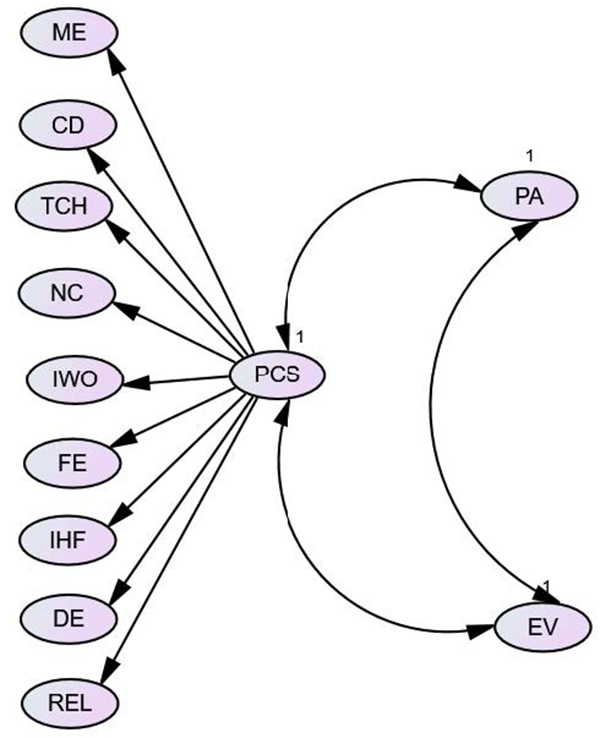
Hierarchical positive coping model
- [1] D. J. Cothran and C. D. Ennis, “Building bridges to student engagement: Communicating respect and care for students in urban high schools,” J. of Research and Development in Education, Vol.33, No.2, pp. 106-117, 2000.
- [2] M. Lyu and D. L. Gill, “Perceived physical competence, enjoyment and effort in same-sex and coeducational physical education classes,” Educational Psychology, Vol.31, No.2, pp. 247-260, 2011. https://doi.org/10.1080/01443410.2010.545105
- [3] S.-G. Baek and H.-J. Choi, “The effect of 12 weeks complexed lower body muscle-strengthening exercise program on fall risk in elderly women,” J. of Digital Convergence, Vol.13, No.10, pp. 533-539, 2015. https://doi.org/10.14400/JDC.2015.13.10.533
- [4] R. Li and R. Huang, “The influence of physical activity on mental well-being in college students: A systematic review,” Frontiers in Psychology, Vol.16, Article No.1573446, 2025. https://doi.org/10.3389/fpsyg.2025.1573446
- [5] R. M. Ryan and E. L. Deci, “Self-determination theory and the facilitation of intrinsic motivation, social development, and well-being,” American Psychologist, Vol.55, No.1, pp. 68-78, 2000. https://doi.org/10.1037//0003-066X.55.1.68
- [6] N. Ntoumanis, “A self-determination approach to the understanding of motivation in physical education,” British J. of Educational Psychology, Vol.71, No.2, pp. 225-242, 2001. https://doi.org/10.1348/000709901158497
- [7] M. E. P. Seligman, “Flourish: A Visionary New Understanding of Happiness and Well-Being,” Simon and Schuster, 2011.
- [8] T. K. Liu, C. H. Tsai, and M. J. Hsu, “Teaching strategies and student satisfaction in physical education,” Taiwan J. of Physical Education, Vol.55, No.1, pp. 101-118, 2020.
- [9] E. Diener, “Subjective well-being,” Psychological Bulletin, Vol.95, No.3, pp. 542-575, 1984. https://doi.org/10.1037/0033-2909.95.3.542
- [10] C. D. Ryff and C. L. M. Keyes, “The structure of psychological well-being revisited,” J. of Personality and Social Psychology, Vol.69, No.4, pp. 719-727, 1995. https://doi.org/10.1037/0022-3514.69.4.719
- [11] P. Ekkekakis, “Pleasure and displeasure from the body: Perspectives from exercise,” Cognition and Emotion, Vol.17, No.2, pp. 213-239, 2003. https://doi.org/10.1080/02699930302292
- [12] A. Bandura and S. Wessels, “Self-Efficacy,” Cambridge University Press, pp. 4-6, 1997.
- [13] R. Bailey, “Physical education and sport in schools: A review of benefits and outcomes,” J. of School Health, Vol.76, No.8, pp. 397-401, 2006. https://doi.org/10.1111/j.1746-1561.2006.00132.x
- [14] S. Yuan and M. You, “Effects of physical activity on college students’ subjective well-being during COVID-19,” J. of Epidemiology and Global Health, Vol.12, No.4, pp. 441-448, 2022. https://doi.org/10.1007/s44197-022-00062-4
- [15] M. Espada, N. Romero-Parra, D. Bores-García, and J. M. Delfa-De La Morena, “Gender differences in university students’ levels of physical activity and motivations to engage in physical activity,” Education Sciences, Vol.13, No.4, Article No.340, 2023. https://doi.org/10.3390/educsci13040340
- [16] Y. Watan, “The effect of cultural sports on Indigenous college students’ identity and subjective well-being,” J. of Indigenous Education and Research, Vol.3, No.1, pp. 41-58, 2020.
- [17] E. Diener (Ed.), “Assessing Well-Being: The Collected Works of Ed Diener,” Springer, 2009.
- [18] G. B. Cunningham, “Development of the physical activity class satisfaction questionnaire (PACSQ),” Measurement in Physical Education and Exercise Science, Vol.11, No.3, pp. 161-176, 2007. https://doi.org/10.1080/10913670701326443
- [19] R. F. Baumeister and M. R. Leary, “The need to belong,” Psychological Bulletin, Vol.117, No.3, pp. 497-529, 1995.
- [20] R. Lazarus and S. Folkman, “Stress and coping,” Vol.18, No.31, pp. 34-42, 1985.
This article is published under a Creative Commons Attribution-NoDerivatives 4.0 Internationa License.