
Research Paper:
Development of a Wireless Measuring System for Grinding Vibrations
Mizuki Uematsu*, Kazuya Kato*,†
 , Motoki Yonezawa**, Tomoya Watanobe**, Kiyoyuki Kikuchi**, and Shinju Ito**
*Shonan Institute of Technology
1-1-25 Tsujido Nishikaigan, Fujisawa, Kanagawa 251-8511, Japan
†Corresponding author
**Kuroda Precision Industries Ltd.
Kawasaki, Japan

In-process measurement of changes in grinding wheel condition is expected to prevent machining defects. A method for monitoring grinding wheel condition through grinding vibration analysis was examined in this study. To achieve this, a measurement device was developed by housing two accelerometers, a compact microcontroller, a wireless transmitter, and two batteries in an acrylic case mounted on the grinding wheel, enabling vibration acquisition and wireless transmission during operation. Two measurement methods were implemented in the developed system. The first is a raw data transmission method, which measures biaxial acceleration at a sampling frequency of 24 kHz and simultaneously transmits the data to a personal computer (PC). The second is an edge computing method, which calculates anomaly scores using a neural network within the microcontroller and transmits only the results. The advantage of the raw data transmission method is that it allows various analyses using the raw acceleration data received by the PC. However, the disadvantage is the heavy load on the network due to the large volume of data transmitted. In contrast, the edge computing method significantly reduces data volume and power consumption by transmitting only anomaly scores, thereby extending battery life. Experiments were conducted using a surface grinding machine. In the raw data transmission method, it was found that the integrated value of the absolute acceleration measured by the developed device strongly correlates with the magnitude of the grinding force. This result indicates that the developed device can estimate the grinding force. In the edge computing method, the anomaly scores calculated within the microcontroller correlated with the grinding force. This confirms that the developed device can estimate the grinding force using this method as well. Furthermore, it was demonstrated that this method can detect abnormalities in wheel rotational speed, changes in wheel condition, and the occurrence of grinding burn.
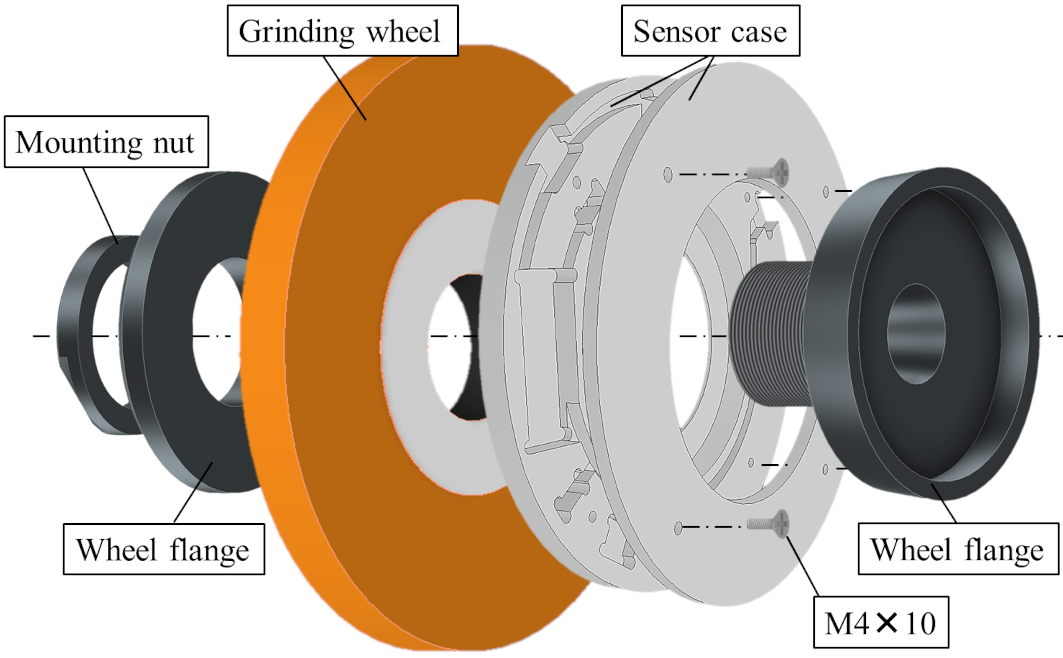
Wireless measuring device for grinding vibrations.
- [1] M. Fujimoto, T. Ninomiya, and H. Mieno, “Effect of wear behavior of grain cutting edges on chatter vibration in creep feed grinding,” J. Jpn. Soc. Abras. Technol., Vol.68, No.1, pp. 33-38, 2024 (in Japanese). https://doi.org/10.11420/jsat.68.33
- [2] F. Bleicher, D. Biermann, W.-G. Drossel, H.-C. Moehring, and Y. Altintas, “Sensor and actuator integrated tooling systems,” CIRP Ann., Vol.72, No.2, pp. 673-696, 2023. https://doi.org/10.1016/j.cirp.2023.05.009
- [3] K. Ohashi, “Measuring techniques and their applications in grinding process,” J. Jpn. Soc. Precis. Eng., Vol.84, No.2, pp. 138-141, 2018 (in Japanese). https://doi.org/10.2493/jjspe.84.138
- [4] Y. Kurahashi, “The latest machining process monitoring technology,” J. Jpn. Soc. Abras. Technol., Vol.62, No.5, pp. 250-253, 2018.
- [5] J. Hsieh and I. Inasaki, “Monitoring of dressing and grinding process with acoustic emission signals,” Trans. Jpn. Soc. Mech. Eng. Ser. C, Vol.51, No.468, pp. 2174-2179, 1985 (in Japanese). https://doi.org/10.1299/kikaic.51.2174
- [6] Y. Nagasu, K. Yamada, K. Maruyama, H. Tsuboi, and M. Kitahara, “Development of determination system for grinding process status by acoustic emission sensor,” Res. Rep. Nagano Prefect. Gen. Ind. Technol. Cent., No.16, pp. 1-5, 2021 (in Japanese).
- [7] K. Yamashita, H. Kondo, and H. Koike, “Estimation of stability of grinding process by acoustic emission sensor,” Rep. Ind. Technol. Cent. Tochigi Prefect., No.21, pp. 66-70, 2024 (in Japanese).
- [8] T. Kasuga et al., “Studies on workpiece surface roughness estimation technology using AE signals during grinding,” Proc. JSPE Semestrial Meet., pp. 567-568, 2024 (in Japanese). https://doi.org/10.11522/pscjspe.2024S.0_567
- [9] Y. Tani, “Vibration in grinding,” Seisan Kenkyu, Vol.34, No.3, pp. 77-82, 1982.
- [10] I. Inasaki and S. Yonezu, “Chatter vibration in flat and cylindrical grinding,” J. Jpn. Soc. Precis. Eng., Vol.35, No.408, pp. 47-53, 1969 (in Japanese). https://doi.org/10.2493/jjspe1933.35.47
- [11] S. Okuyama, “Grinding engineering for young engineers: Part 10 causes of chatter vibration and its suppression,” J. Jpn. Soc. Abras. Technol., Vol.59, No.11, pp. 651-654, 2015.
- [12] M. Wakuda, I. Inasaki, K. Ogawa, and M. Takahara, “Monitoring of the grinding process with an AE sensor integrated CBN wheel,” J. Jpn. Soc. Precis. Eng., Vol.59, No.2, pp. 275-280, 1993 (in Japanese). https://doi.org/10.2493/jjspe.59.275
- [13] B. Karpuschewski, M. Wehmeier, and I. Inasaki, “Grinding monitoring system based on power and acoustic emission sensors,” CIRP Ann., Vol.49, No.1, pp. 235-240, 2000. https://doi.org/10.1016/S0007-8506(07)62936-9
- [14] B. Varghese, S. Pathare, R. Gao, C. Guo, and S. Malkin, “Development of a sensor-integrated ‘intelligent’ grinding wheel for in-process monitoring,” CIRP Ann., Vol.49, No.1, pp. 231-234, 2000. https://doi.org/10.1016/S0007-8506(07)62935-7
- [15] E. Brinksmeier, C. Heinzel, and L. Meyer, “Development and application of a wheel based process monitoring system in grinding,” CIRP Ann., Vol.54, No.1, pp. 301-304, 2005. https://doi.org/10.1016/S0007-8506(07)60108-5
- [16] R. Matsuda, M. Shindou, T. Hirogaki, and E. Aoyama, “Monitoring of rotational vibration in tap and endmill processes with a wireless multifunctional tool holder system,” Int. J. Automation Technol., Vol.12, No.6, pp. 876-882, 2018. https://doi.org/10.20965/ijat.2018.p0876
- [17] R. Matsuda, M. Shindou, T. Hirogaki, and E. Aoyama, “Study on monitoring tool temperature and vibration in drilling and countersinking processes with a multi-functional wireless communication tool holder system,” Trans. JSME, Vol.85, No.872, Article No.18-00176, 2019 (in Japanese). https://doi.org/10.1299/transjsme.18-00176
- [18] T. Yamamoto, R. Matsuda, M. Shindou, T. Hirogaki, and E. Aoyama, “Monitoring of vibrations in free-form surface processing using ball nose end mill tools with wireless tool holder systems,” Int. J. Automation Technol., Vol.15, No.3, pp. 335-342, 2021. https://doi.org/10.20965/ijat.2021.p0335
- [19] J. V. Abellan-Nebot and F. Romero Subirón, “A review of machining monitoring systems based on artificial intelligence process models,” Int. J. Adv. Manuf. Technol., Vol.47, No.1, pp. 237-257, 2010. https://doi.org/10.1007/s00170-009-2191-8
- [20] L. Hou and N. W. Bergmann, “Novel industrial wireless sensor networks for machine condition monitoring and fault diagnosis,” IEEE Trans. Instrum. Meas., Vol.61, No.10, pp. 2787-2798, 2012. https://doi.org/10.1109/TIM.2012.2200817
- [21] K. Kato, K. Utsumi, K. Nishikawa, and A. Nomura, “Development of wireless cutting vibration monitoring device fixed to tool holder,” Int. J. Abras. Technol., Vol.11, No.1, pp. 1-16, 2022. https://doi.org/10.1504/IJAT.2022.125266
- [22] Y. Okayama, “Outline of edge computing that supports cyber physical system,” Oyo Buturi, Vol.89, No.9, pp. 535-538, 2020 (in Japanese). https://doi.org/10.11470/oubutsu.89.9_535
- [23] M. Uchida, S. Ishida, T. Tabaru, and H. Miyamoto, “Anomaly detection of rotary vacuum pump using thin AE sensor and reconstruction error of autoencoder,” Trans. Soc. Instrum. Control Eng., Vol.54, No.7, pp. 599-605, 2018 (in Japanese). https://doi.org/10.9746/sicetr.54.599
- [24] K. Oda, H. Suwa, and K. Murakami, “Cutting anomaly detection in end-milling by multimodal variational autoencoder,” Trans. JSME, Vol.89, No.918, Article No.22-00290, 2023 (in Japanese). https://doi.org/10.1299/transjsme.22-00290
- [25] S. Asahi et al., “Proposal of failure prediction method of factory equipment by vibration data with recurrent autoencoder,” Trans. JSME, Vol.86, No.891, Article No.20-00020, 2020 (in Japanese). https://doi.org/10.1299/transjsme.20-00020
- [26] T. Hayakawa, “Spresense-Playground.” https://github.com/TomonobuHayakawa/Spresense-Playground/tree/master/IntegrationWithProcessing/FrequencyCharacteristi [Accessed August 17, 2026]
- [27] Sony Semiconductor Solutions Corporation and Y. Ota, “Low-Power Edge AI with SPRESENSE,” O’Reilly Japan, 2022.
This article is published under a Creative Commons Attribution-NoDerivatives 4.0 Internationa License.