
Research Paper:
Fused Filament Fabrication Using Cellulose Nanofiber Composites: Development of Filament with Higher Fiber Content and Evaluation of Fabricated Objects
Yosuke Kiminami* and Toshitake Tateno**,†

*Graduate School of Science and Technology, Meiji University
1-1-1 Higashimita, Tama-ku, Kawasaki, Kanagawa 214-8571, Japan
**Meiji University
Kawasaki, Japan
†Corresponding author

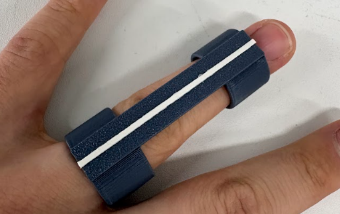
Fused filament fabrication is a type of material extrusion process category of additive manufacturing. Because the material is prepared in the form of filaments, a wide variety of materials including composite materials with continuous fibers can be used. With the recent increase in environmental consciousness, the use of biodegradable composites using polylactic acid (PLA) and continuous cellulose nanofiber (CNF) strings has garnered attention from the scientific community. However, the fiber content of the composites remains low, preventing full exploitation of the ultrahigh intrinsic strength of CNFs. In this study, we proposed two methods to increase fiber content. First, we modified the cross-sectional shape of the filament from circular to rectangular to increase the fiber content. Second, we optimized the process parameters during filament fabrication by adjusting the feed rates of continuous CNFs and PLA, resulting in a higher fiber content up to 35%. Following this, filaments with higher fiber content were used in fabrication experiments. Tensile tests of the fabricated specimens showed that the mechanical strength increased with the fiber content. Finally, we present an application example of the developed CNF filament for reinforcing finger orthosis.
FFF using continuous CNF composites
- [1] A. N. Dickson, J. N. Barry, K. A. McDonnell, and D. P. Dowling, “Fabrication of continuous carbon, glass and Kevlar fibre reinforced polymer composites using additive manufacturing,” Addit. Manuf., Vol.16, pp. 146-152, 2017. https://doi.org/10.1016/j.addma.2017.06.004
- [2] V. Acanfora, A. Sellitto, A. Russo, M. Zarrelli, and A. Riccio, “Experimental investigation on 3D printed lightweight sandwich structures for energy absorption aerospace applications,” Aerosp. Sci. Technol., Vol.137, Article No.108276, 2023. https://doi.org/10.1016/j.ast.2023.108276
- [3] K. Jimbo, T. Shitani, S. Nakajima, and S. Morita, “Design optimization of continuous fiber arrangement using lamination parameters in material extrusion-based additive manufacturing,” Int. J. Automation Technol., Vol.18, No.5, pp. 712-720, 2024. https://doi.org/10.20965/ijat.2024.p0712
- [4] X. Kong, G. Sun, Q. Luo, V. Brykin, and J. Qian, “Experimental and theoretical studies on 3D printed short and continuous carbon fiber hybrid reinforced composites,” Thin-Walled Struct., Vol.205, Part A, Article No.112406, 2024. https://doi.org/10.1016/j.tws.2024.112406
- [5] Department of Economic and Social Affairs, United Nations, “Transforming our world: The 2030 Agenda for Sustainable Development,” https://sdgs.un.org/2030agenda [Accessed March 5, 2026]
- [6] T. R. Walker, L. Wang, A. Horton, and E. G. Xu, “Micro(nano)plastic toxicity and health effects: Special issue guest editorial,” Environ. Int., Vol.170, Article No.107626, 2022. https://doi.org/10.1016/j.envint.2022.107626
- [7] F. A. S. Islam, “The effects of plastic and microplastic waste on the marine environment and the ocean,” Eur. J. Environ. Earth Sci., Vol.6, No.3, pp. 1-9, 2025. https://doi.org/10.24018/ejgeo.2025.6.3.508
- [8] D. Xing et al., “3D-printing continuous plant fiber/polylactic acid composites with lightweight and high strength,” Polym. Compos., Vol.46, No.6, pp. 4967-4980, 2025. https://doi.org/10.1002/pc.29178
- [9] V. Dananjaya, M. Yang, Y. Zheng, and C. Abeykoon, “Effect of filler characteristics and processing route on bamboo powder-reinforced PLA composites,” J. Clean. Prod., Vol.537, Article No.147193, 2025. https://doi.org/10.1016/j.jclepro.2025.147193
- [10] M. D. H. Beg, K. L. Pickering, J. O. Akindoyo, and C. Gauss, “Recyclable hemp hurd fibre-reinforced PLA composites for 3D printing,” J. Mater. Res. Technol., Vol.33, pp. 4439-4447, 2024. https://doi.org/10.1016/j.jmrt.2024.10.082
- [11] Y. Yaguchi, K. Takeuchi, T. Waragai, and T. Tateno, “Durability evaluation of an additive manufactured biodegradable composite with continuous natural fiber in various conditions reproducing usage environment,” Int. J. Automation Technol., Vol.14, No.6, pp. 959-965, 2020. https://doi.org/10.20965/ijat.2020.p0959
- [12] T. Yi et al., “From cellulose to cellulose nanofibrils—A comprehensive review of the preparation and modification of cellulose nanofibrils,” Materials, Vol.13, No.22, Article No.5062, 2020. https://doi.org/10.3390/ma13225062
- [13] Q. Wang, C. Ji, L. Sun, J. Sun, and J. Liu, “Cellulose nanofibrils filled poly(lactic acid) biocomposite filament for FDM 3D printing,” Molecules, Vol.25, No.10, Article No.2319, 2020. https://doi.org/10.3390/molecules25102319
- [14] Z. Zhang et al., “3D printing of cellulose nanofiber/polylactic acid composites via an efficient dispersion method,” Compos. Commun., Vol.43, Article No.101731, 2023. https://doi.org/10.1016/j.coco.2023.101731
- [15] T. Tateno, “Environmentally conscious light-weight design and fabrication with continuous cellulose nanofiber string in additive manufacturing,” Proc. EcoDesign 2023, Article No.P3-2, 2024.
- [16] T. Tateno, A. Nishida, and Y. Kiminami, “Effect of CNF string on tensile strength of bio-degradable parts fabricated in fused filament fabrication,” Int, Conf, Exp. Mech., pp. 800-801, 2025.
- [17] Z. Zhang, Y. Long, Z. Yang, K. Fu, and Y. Li, “An investigation into printing pressure of 3D printed continuous carbon fiber reinforced composites,” Compos. A: Appl. Sci. Manuf., Vol.162, Article No.107162, 2022. https://doi.org/10.1016/j.compositesa.2022.107162
- [18] Q. He, H. Wang, K. Fu, and L. Ye, “3D printed continuous CF/PA6 composites: Effect of microscopic voids on mechanical performance,” Compos. Sci. Technol., Vol.191, Article No.108077, 2020. https://doi.org/10.1016/j.compscitech.2020.108077
- [19] C. O. Balderrama-Armendariz, A. A. Maldonado-Macias, E. MacDonald, J. I. Aguilar-Duque, and R. Garcia-Pereyra, “Square nozzle to improve mechanical performance and density in fused filament Fabrication additive manufacturing,” Manuf. Lett., Vol.40, pp. 179-184, 2024. https://doi.org/10.1016/j.mfglet.2024.05.004
- [20] H. Wang et al., “Additive manufacturing of continuous fiber reinforced composites with variable volume fractions,” Compos. A: Appl. Sci. Manuf., Vol.187, Article No.108504, 2024. https://doi.org/10.1016/j.compositesa.2024.108504
This article is published under a Creative Commons Attribution-NoDerivatives 4.0 Internationa License.