
Paper:
Changes in the Debris Flow Threshold Owing to Volcanic Eruptions: Evaluation with Numerical Simulations
Tomoya Iwai*,†
 , Shusuke Miyata**
, and Kazuki Yamanoi***
, Shusuke Miyata**
, and Kazuki Yamanoi***
*Graduate School of Engineering, Kyoto University
Kyoto Daigaku-katsura, Nishikyo-ku, Kyoto, Kyoto 615-8530, Japan
†Corresponding author
**Graduate School of Agriculture, Kyoto University
Kyoto, Japan
***Disaster Prevention Research Institute, Kyoto University
Kyoto, Japan

It is empirically known that debris flows are more likely to occur during and after volcanic eruptions. This study conducted numerical simulations to examine the effects of reduced infiltration capacity and increased sediment supply owing to volcanic activity on the rainfall threshold that causes debris flows. Rainfall runoff analysis was performed using various rainfall intensities as constant input conditions. The occurrence of debris flows was evaluated based on theoretical and experimental formulas. The mechanism by which sediment in river channels transforms into debris flow was discussed in terms of two processes: sediment sliding as a mass and sediment being eroded by surface flow. This study clarified the critical role of infiltration capacity in debris flow occurrence. When infiltration capacity is low, surface runoff becomes more dominant, easily entraining sediment and triggering debris flows—even during short or weak rainfall events. Quantitative analysis revealed that when infiltration capacity drops from 100 mm/h to 10 mm/h, the cumulative rainfall required to trigger debris flows decreases to only a few percent of the pre-eruption requirement. However, when volcanic activity supplies large volumes of sediment to river channels, the mechanism can shift to mass sliding. In such cases, debris flows may occur even under relatively weak but prolonged rainfall. The results indicate the importance of both sediment erosion and mass sliding processes in debris flow occurrence.
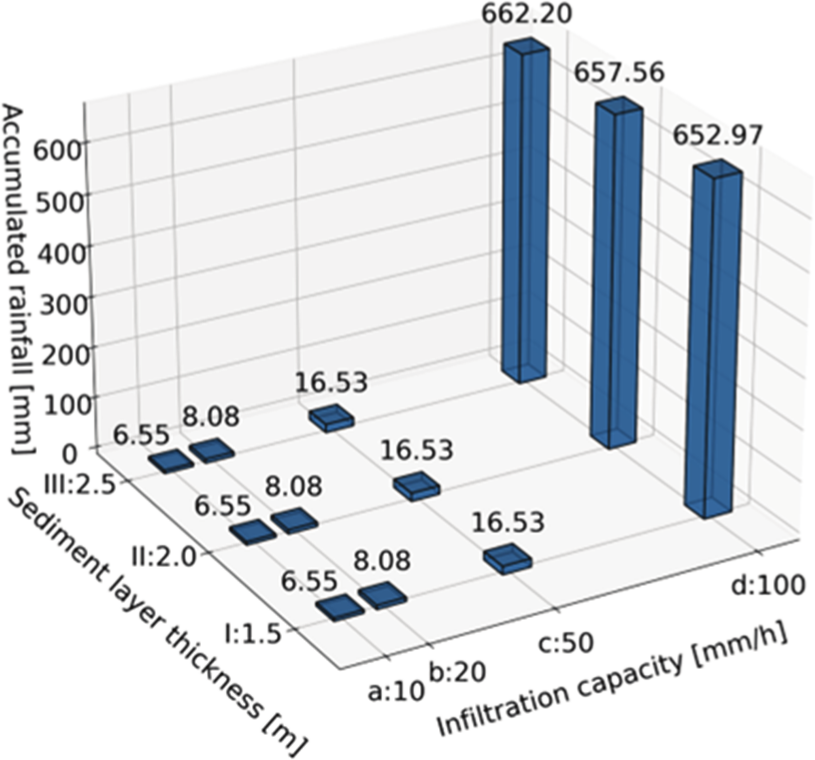
Rainfall threshold for debris flow occurrence
- [1] T. Takahashi, “Debris Flow: Mechanics, Prediction and Countermeasures,” Taylor & Francis, 2007.
- [2] H. Ikeya, “The mechanism on the occurrence of debris flows in the Mizunashi River, Unzen Volcano,” J. of the Japan Society of Erosion Control Engineering, Vol.46, No.2, pp. 15-21, 1993 (in Japanese). https://doi.org/10.11475/sabo1973.46.15
- [3] T. Harada, M. Hirano, and K. Kawahara, “Runoff analysis of debris flow in the Mizunashi River at Mt. Unzen,” J. of the Japan Society of Erosion Control Engineering, Vol.52, No.1, pp. 3-9, 1999 (in Japanese). https://doi.org/10.11475/sabo1973.52.3
- [4] J. J. Major and T. Yamakoshi, “Decadal-scale change of infiltration characteristics of a tephra-mantled hillslope at Mount St Helens, Washington,” Hydrological Processes, Vol.19, Issue 18, pp. 3621-3630, 2005. https://doi.org/10.1002/hyp.5863
- [5] H. Tsunetaka, Y. Shinohara, N. Hotta, C. Gomez, and Y. Sakai, “Multi-decadal changes in the relationships between rainfall characteristics and debris-flow occurrences in response to gully evolution after the 1990–1995 Mount Unzen eruptions,” Earth Surface Processes and Landforms, Vol.46, Issue 11, pp. 2141-2162, 2021. https://doi.org/10.1002/esp.5148
- [6] K. S. Rodolfo and A. T. Arguden, “Rain-lahar generation and sediment-delivery systems at Mayon Volcano, Philippines” R. V. Fisher and G. A. Smith (Eds.), “Sedimentation in Volcanic Settings,” pp. 71-87, SEPM Society for Sedimentary Geology, 1991. https://doi.org/10.2110/pec.91.45
- [7] F. Lavigne, J.-C. Thouret, B. Voight, H. Suwa, and A. Sumaryono, “Lahars at Merapi Volcano, central Java: An overview,” J. of Volcanology and Geothermal Research, Vol.100, Issues 1-4, pp. 423-456, 2000. https://doi.org/10.1016/S0377-0273(00)00150-5
- [8] T. Ersöz and Y. Gonda, “Investigation of different lahar types with rainfall intensity duration curves in Arimura River basin of Sakurajima Volcano,” Int. J. of Erosion Control Engineering, Vol.17, Issue 1, pp. 1-14, 2024. https://doi.org/10.13101/ijece.17.1
- [9] M. Fujita, K. Yamanoi, and G. Suzuki, “A method for predicting debris-flow occurrence based on a rainfall and sediment runoff model,” Proc. of 7th Int. Conf. on Debris-Flow Hazard Mitigation, 2019. http://doi.org/10.25676/11124/173209
- [10] K. Yamanoi, “Study on the development and application of a sediment discharge model that considers sediment production and sediment supply processes,” Ph.D. thesis, Kyoto University, 2007 (in Japanese). https://doi.org/10.14989/doctor.k20343
- [11] T. Iwai, S. Miyata, K. Yamanoi, and M. Fujita, “Sensitivity analysis of the field that stream bed sediment becomes debris flow: Application of the improved SiMHiS to the Jinzu River system Hiru-dani,” J. of the Japan Society of Erosion Control Engineering, Vol.77, No.1, pp. 17-24, 2024 (in Japanese). https://doi.org/10.11475/sabo.77.1_17
- [12] Jinzu River System Erosion Control Works Office, Hokuriku Regional Construction Bureau, Ministry of Construction, “Learning from 80 years of erosion control in Oku-Hida,” 2000 (in Japanese).
- [13] T. Saito, S. Sawamura, R.Tamura, S. Seki, K. Amita, T. Mishima, and S. Ohsawa, “Chemical and isotopic compositions of fumarolic gases from Yakedake Volcano, Japan,” Bulletin of the Volcanological Society of Japan, Vol.64, No.1, pp. 1-9, 2019 (in Japanese). https://doi.org/10.18940/kazan.64.1_1
- [14] S. Ohmi, “Seismic swarm activity in the Hida Mountain Range, Central Japan, in 2020,” DPRI Annuals, No.64 B, pp.40-47, 2021 (in Japanese).
- [15] S. Egashira and K. Matsuki, “A method for predicting sediment runoff caused by erosion of stream channel bed,” Proc. of Hydraulic Engineering, Vol.44, pp. 735-740, 2000 (in Japanese). https://doi.org/10.2208/prohe.44.735
- [16] T. Takahashi, “Mechanical characteristics of debris flow,” J. of the Hydraulic Division, Vol.104, No.8, pp. 1153-1169, 1978. https://doi.org/10.1061/JYCEAJ.0005046
- [17] H. Suwa, T. Manaka, and A. Inaniwa, “Occurrence of debris flows and their scales in the Kamikamihori Valley of Mount Yakedake,” DPRI Annuals, No.32 B-1, pp. 229-247, 1989 (in Japanese).
- [18] C. Gregoretti, “The initiation of debris flow at high slopes: Experimental results,” J. of Hydraulic Research, Vol.38, Issue 2, pp. 83-88, 2000. https://doi.org/10.1080/00221680009498343
- [19] C. Gregoretti and G. D. Fontana, “The triggering of debris flow due to channel-bed failure in some alpine headwater basins of the Dolomites: Analyses of critical runoff,” Hydrological Processes, Vol.22, No.13, pp. 2248-2263, 2008. https://doi.org/10.1002/hyp.6821
- [20] Y. Hirakawa, K. Okano, T. Ueno, D. Tsutsumi, S. Miyata, and Y. Satofuka, “Topographical and geological characteristics of source areas of debris flows on hillslope covered with pyroclastic-flow deposits for 20 years after the eruption of Mt. Unzen,” J. of the Japan Society of Erosion Control Engineering, Vol.71, No.3, pp. 12-20, 2018 (in Japanese). https://doi.org/10.11475/sabo.71.3_12
- [21] N. Yagi and R. Yatabe, “A microscopic consideration on shearing characteristic of decomposed granite soil,” J. of JSCE, Vol.364, No.III-4, pp. 133-141, 1985 (in Japanese). https://doi.org/10.2208/jscej.1985.364_133
This article is published under a Creative Commons Attribution-NoDerivatives 4.0 Internationa License.